

Goodyear welted Italian shoes are worth the extra money if you plan to wear them often and want them resoled rather than replaced. The welt construction lets a cobbler replace the sole without rebuilding the shoe, so a single pair can outlast several cheaper, glued pairs. If you wear dress shoes a few times a year, the premium buys you less.
- Goodyear welted Italian shoes are worth the premium for frequent wearers who will resole them.
- Welted construction allows repeated resoling, which is where the extra cost pays back.
- Occasional wearers get less from the premium; a well-made cemented shoe can be enough.
- Check construction, leather and fit before price when comparing pairs.
Is it worth paying more for Goodyear welted Italian shoes?
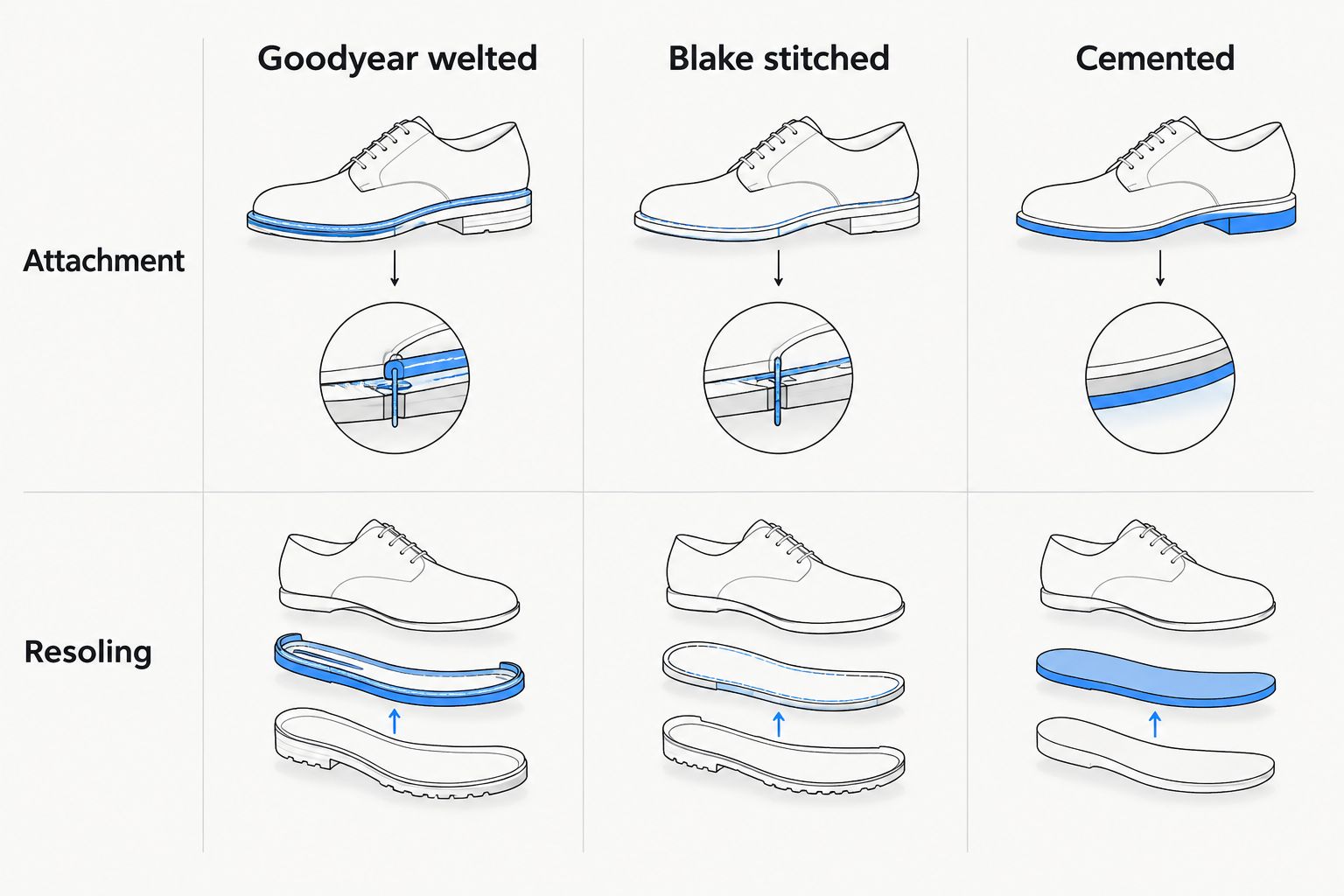
Yes, if you wear the shoes weekly and plan to maintain them. Goodyear welting stitches a strip of leather, the welt, to the upper and to a rib on the insole. The outsole is then stitched to the welt. Because the outsole is attached to the welt and not to the shoe's core, a cobbler can remove a worn sole and fit a new one. That is the practical reason the construction costs more: more hand and machine steps, and a design built to be repaired.
The premium is best judged against how long you will keep the shoes. For the broader picture of lifespan, see our guide on how long Italian leather dress shoes last.
Goodyear welted vs. other constructions
| Construction | How the sole is attached | Resoling | Best for |
|---|---|---|---|
| Goodyear welted | Stitched to a welt, which is stitched to the upper | Straightforward, repeatable | Daily and weekly wear, long-term ownership |
| Blake stitched | Stitched directly through insole and outsole | Possible, needs specialist machinery | Slimmer, closer-cut profiles |
| Cemented | Glued to the upper | Limited or not practical | Occasional wear, lighter shoes |
Pros of Goodyear welting: repairable soles, a cork-filled bed that molds to your foot over time, and a sturdier structure. Cons: heavier and stiffer at first, a bulkier profile, and a higher purchase price. Not every Italian shoe is welted, and not every welted shoe has good leather, so verify the construction listed for the specific pair.
Why the price gap exists
- More production steps. Welting adds stitching and assembly time compared with gluing a sole on.
- Materials. Welted shoes usually pair the construction with fuller leather linings and leather soles, though this varies by maker.
- Repairability. You are paying for a shoe designed to be serviced, not discarded.
- Maker and sourcing. Small-batch Italian workshops and established designer brands price differently.
- Finishing. Hand-burnished or exotic-skin finishes add cost independent of construction.
When the premium pays off
The math favors welted shoes when you wear one pair several times a week, rotate between two or three pairs, and keep them conditioned. A resole costs a fraction of a new pair; our breakdown of how much it costs to resole Italian dress shoes covers what to expect, and how to resole Italian leather dress shoes explains the process.
When the premium does not pay off
- You wear dress shoes a handful of times a year, such as weddings or occasional events.
- You prefer a sleek, lightweight shoe and will not resole.
- You are buying sneakers or casual slip-ons, where welting is uncommon and less relevant.
In those cases, put the money into leather quality and fit instead. A shoe that fits well gets worn; one that pinches stays in the box. How to measure your foot for Italian dress shoes is a useful starting point.
Does Goodyear welting make shoes more comfortable?
Over time, often yes. The cork footbed commonly found in welted shoes compresses and shapes to your foot with wear. The tradeoff is a longer break-in period. Read how long it takes to break in Italian leather shoes before a big event.
Are welted Italian shoes always handmade?
No. Welting can be done with machinery, and handmade claims vary by maker. Check the product description for what the maker states about construction and origin rather than assuming. Our guide on how to spot genuine Italian leather shoes covers the checks worth making.
How do you make welted shoes last?
Rotate pairs, use cedar shoe trees, condition the leather and resole before the welt is damaged. A neglected welted shoe loses much of its advantage.
Browse Italian shoes for men
Check each product page for the construction the maker lists.
FAQ
Is it worth paying more for Goodyear welted Italian shoes?
Yes, if you wear them often and plan to resole them. The welt lets a cobbler replace the sole, so one pair can serve for years. Occasional wearers get less value.
What does Goodyear welted mean?
It means the outsole is stitched to a welt, which is stitched to the upper and insole rib. This allows the sole to be replaced without rebuilding the shoe.
Are Goodyear welted shoes better than Blake stitched?
They are different, not strictly better. Goodyear welted shoes are easier to resole and sturdier; Blake stitched shoes are usually slimmer and lighter.
Can you resole cemented shoes?
Often not practically. Glued soles are typically replaced along with the shoe, which is why cemented pairs suit occasional wear.
Are Goodyear welted shoes heavier?
Generally yes. The extra layers and sturdier build add some weight and stiffness, which eases as the shoe breaks in.
How do I know if an Italian shoe is welted?
Look for a visible stitch line around the outsole edge and confirm the construction in the product description. If it is not listed, ask the retailer before buying.
One last thing
Before paying a premium for construction, check the pair's last and your measurements. A welted shoe that does not fit loses every advantage described here, and a well-fitting cemented shoe will outwear a poorly fitting welted one in your closet. If you are still weighing quality against cost, read whether handmade Italian dress shoes are worth buying in 2026.