

A well-made pair of Italian leather dress shoes lasts a decade or more when you rotate them, keep shoe trees in them, condition the leather and resole them before the welt or midsole wears through. Construction and care decide the outcome, not the country on the label.
- Italian leather dress shoes last a decade or more with rotation, shoe trees, conditioning and timely resoling.
- Construction sets the ceiling: welted pairs can be resoled repeatedly, cemented pairs usually cannot.
- Wearing the same pair daily shortens life more than any other single habit.
- Resole before the sole wears into the welt or midsole; waiting turns a cheap repair into a dead pair.
Why this matters
How long Italian leather dress shoes last is a purchasing question as much as a care question. A pair that gets two seasons of use costs far more per wear than a pair that gets ten years, even if the second pair costs more on day one.
The verdict for 2026: if you wear dress shoes weekly, buy a resoleable pair and rotate it. That is the best long-term value in men's footwear. Everything below explains why, and what to check before you buy.
How long do Italian leather dress shoes last?
A quality pair worn two or three days a week, rested between wears and maintained, lasts a decade or more. The same shoe worn every day with no trees and no conditioning can fail in a fraction of that time. The leather is rarely what gives out first. The sole, the heel and the lining go before the upper does.
The lifespan also depends on what "last" means. A shoe can stay wearable on the outside while the sole is past saving. Plan for the sole to be replaced at least once in the life of a good pair.
Here is how the main construction types compare in 2026:
| Construction | Resoleable | Typical outcome | Best for |
|---|---|---|---|
| Goodyear welted | Yes, repeatedly | Longest life; sole replaced without disturbing the upper | Daily office wear, long-term ownership |
| Blake stitched | Yes, by a capable cobbler | Sleeker and lighter; fewer resoles | Slim dress shoes, occasional to regular wear |
| Cemented | Rarely practical | Life ends when the sole does | Occasional wear, trend-led styles |
The table describes the construction methods in general, not any specific pair. Check the product description for construction details before you buy, and if the listing does not state it, ask.
Pros of resoleable Italian dress shoes: the upper keeps molding to your foot for years, repairs cost far less than replacement, and good calf leather develops a patina instead of simply wearing out.
Cons: they cost more upfront, they take a break-in period, and they need a maintenance habit you will actually keep.
Goodyear welted: the longest-lasting build
In a welted shoe, the sole is stitched to a strip (the welt) that is stitched to the upper. A cobbler can remove the worn sole and attach a new one without cutting into the upper. That is why welted pairs are the ones people hand down.
The limit is the welt and the footbed. Once the welt is cut through or the cork filling collapses, the shoe is much harder to save. This is why timing matters, and it is covered in the guide on how to resole Italian leather dress shoes.
Blake stitched: slimmer, still repairable
A Blake stitch sews the upper directly to the sole from the inside. The result is a closer, lighter profile that many Italian makers favor for elegant, narrow lasts. It can be resoled, but the repair needs a cobbler with the right machine, and the stitch passes through the insole, so there is less margin for repeated work.
Cemented: the shortest runway
Cemented shoes glue the sole to the upper. They are lighter and cheaper to make, and they are fine for occasional wear. When the sole wears out, replacement is usually not worth it. If you are buying for daily use, this is the construction to avoid.
Why lifespan varies
Two men can buy the same shoe and get very different results. These are the factors that account for most of the gap:
- Rotation. Leather absorbs moisture from your feet. Resting a pair for at least a day between wears lets it dry and keeps the lining and structure intact.
- Shoe trees. Cedar or similar wooden trees absorb moisture and hold the shape of the toe box, which limits deep creasing. See how to use shoe trees to maintain Italian leather shoes.
- Conditioning. Dry leather cracks at the flex point. Regular conditioning keeps it supple. The method is in the guide on how to condition Italian leather shoes to prevent cracking.
- Construction and leather grade. Welted and stitched builds with full-grain calf outlast corrected-grain leather on a cemented sole.
- Where you walk. City pavement, wet weather and road salt wear leather and soles faster than carpeted offices.
- Fit. A shoe that is too loose slips and wears at the heel and lining; one that is too tight stresses the seams.
The care routine works as a loop, not a one-time job:
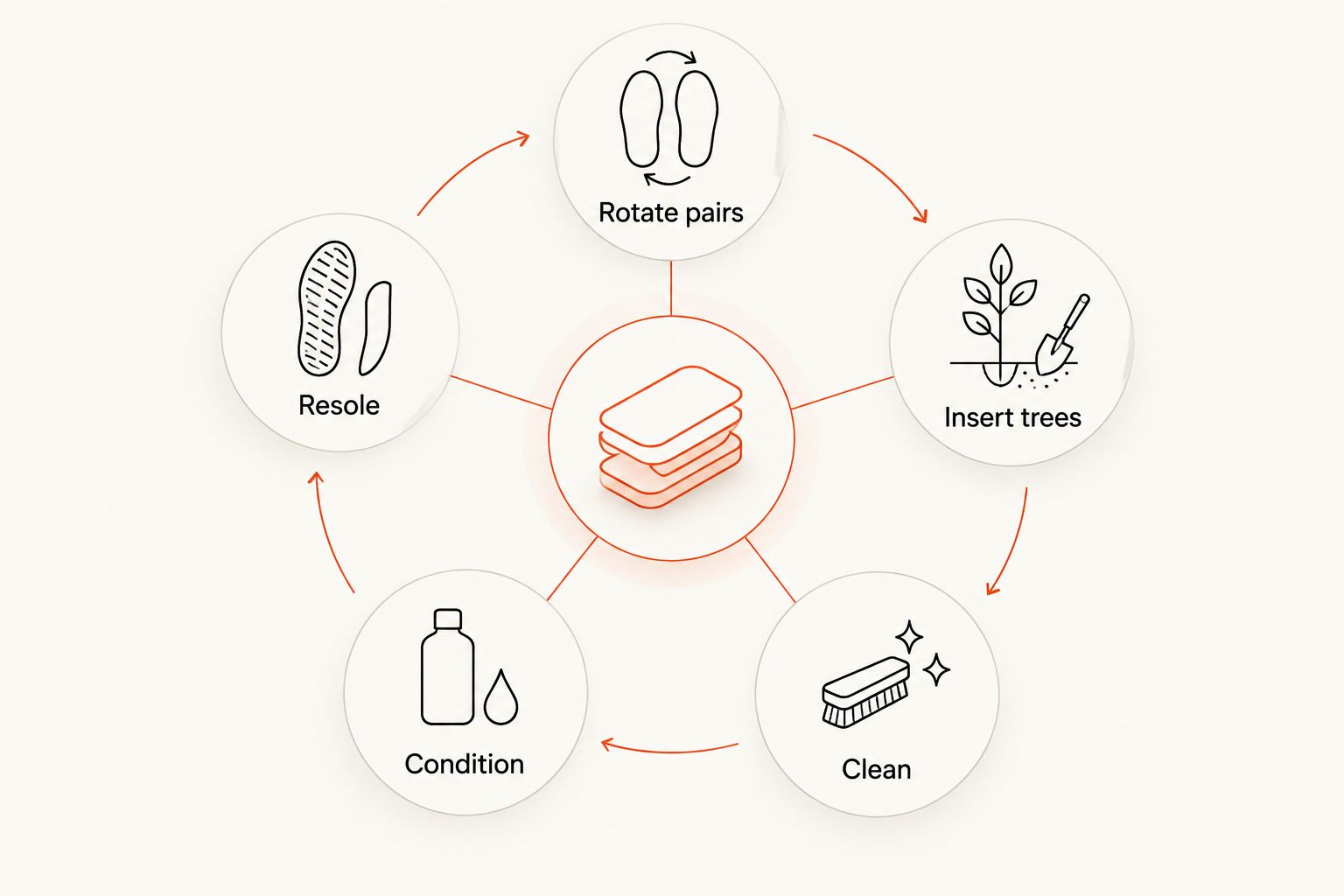
None of this requires special products. It requires doing the same few things consistently. Cleaning and polishing sit in the middle of the loop: wipe off dirt after wearing, and use cream polish to feed and protect the leather instead of letting grit work into the grain.
What shortens the life of Italian dress shoes?
The fastest ways to ruin a good pair are wearing it daily, leaving it wet near a heater, storing it without trees and skipping the cobbler until the sole is gone. Water is the most common cause of damage. If a pair gets soaked, dry it slowly and at room temperature, as covered in how to dry wet leather dress shoes without ruining them.
When should you resole Italian leather dress shoes?
Resole when the sole has worn thin but before it reaches the welt or the midsole. A cobbler can tell you in seconds. If you can see the stitching on the outsole wearing away, or the heel has worn down unevenly, book the repair. A heel cap or rubber half-sole added early extends the original sole's life and costs far less than a full resole.
Do exotic-skin and suede shoes last as long as calf leather?
Not by default. Suede and exotic skins such as crocodile and alligator are more sensitive to moisture and abrasion, and each needs its own care. They can last many years when stored and cleaned correctly, and they suit less frequent wear. For daily office use, smooth calf on a resoleable build is the safer long-term choice.
Are Italian leather dress shoes worth it for longevity?
Only when the construction and leather support it. "Made in Italy" alone says nothing about how long a shoe will last. A cemented shoe from any country wears out faster than a welted one. To judge a pair, look at the sole attachment, the leather quality and the lining, and read the product description for stated materials. The guide on how to spot genuine Italian leather shoes is a useful checklist.
What to look at when you shop
When you buy from MensItalianShoes in 2026, work through this short list:
- Read the listed upper and lining materials. Leather lining holds up better against sweat than synthetic.
- Look for the sole construction in the description. If it is not stated, treat it as unknown.
- Check that the shoe comes in your width and half sizes, since fit drives wear.
- Decide how often you will wear the pair. Daily wearers should buy two pairs and rotate.
The pairs below are leather-based styles from the store's current range. Review each listing for materials and construction details before you decide.


FAQ
How long do Italian leather dress shoes last?
A well-made pair lasts a decade or more with rotation, shoe trees, conditioning and timely resoling. Construction matters most: welted pairs can be resoled repeatedly, cemented pairs usually cannot.
Can Italian leather dress shoes be resoled?
Yes, if they are welted or Blake stitched. Welted shoes are the easiest to repair. Cemented shoes are rarely worth resoling.
Should I wear the same dress shoes every day?
No. Rest each pair for at least a day between wears so the leather and lining can dry. Rotating two pairs is the simplest way to extend the life of both.
Do shoe trees really make dress shoes last longer?
Yes. Wooden trees absorb moisture and hold the shoe's shape, which reduces deep creasing and cracking at the flex point.
Is Italian leather better than other leather?
Not automatically. Longevity depends on the grade of leather, the construction and your care. Check the listed materials and build instead of relying on origin alone.
Do exotic-skin dress shoes last as long as calf leather?
They can last many years with correct storage and cleaning, but they are more sensitive to moisture and abrasion. They suit occasional wear better than daily office use.
When should I resole my leather dress shoes?
Resole when the outsole is thin but before it wears into the welt or midsole. Early repair keeps the shoe saveable and costs less.
One last thing
The cheapest way to extend the life of a leather dress shoe is to buy a second pair. Two pairs worn on alternate days each get the rest the leather needs, and each pair ends up with fewer days of wear over the same period. In 2026, that habit does more for longevity than any product on a shelf.