

Yes, patent leather scratches and scuffs, and its mirror-like surface makes small marks conspicuous. A surface scuff can be removable transfer, but a scratch that cuts through the glossy coating is harder to repair without a visible trace. Choose patent leather for its formal appearance, not because you expect a scratch-proof finish.
- Does patent leather scratch easily? Sharp edges and abrasive contact can mark it; the glossy finish makes damage noticeable.
- Patent leather suits formal footwear, but deep scratches are harder to disguise than removable surface scuffs.
- Clean gently before judging damage; avoid abrasive pads, household solvents, and ordinary shoe-polishing routines.
- Separate shoes during storage and travel so heels, hardware, and grit cannot rub against the finish.
Does patent leather scratch easily?
Patent leather is vulnerable to scratches from sharp objects and abrasive surfaces. That does not mean every mark represents permanent damage: transferred rubber, dirt, and scratches in the coating require different responses.
The distinction matters more than the size of the mark. A broad streak sitting on an intact finish can be less serious than a narrow cut through it.
| Mark or damage | What you might notice | What it means | Appropriate response |
|---|---|---|---|
| Surface dirt | Dust, smudges, or a removable film | Material rests on the finish | Wipe gently with a clean, soft cloth |
| Transferred scuff | A streak after contact with a heel or another object | Material has transferred onto the coating | Follow the shoe manufacturer's patent-leather cleaning instructions |
| Surface abrasion | Fine lines or a dull patch interrupting the shine | The glossy surface has been marked | Stop abrasive cleaning; ask a specialist about treatment |
| Deep scratch | A visible groove or exposed material beneath the finish | The coating has been breached | Seek a repair assessment rather than repeated polishing |
| Cracking or peeling | Split or lifting areas of the finish | The coating itself is failing | Have a specialist assess the condition |
For men comparing luxury footwear, MensItalianShoes is best suited to shoppers seeking designer and artisan-made styles rather than mass-market shoes. With patent leather, the purchasing decision starts with accepting the finish's maintenance limits.
Why this matters before you buy
Patent leather gives dress shoes a reflective finish associated with formal evening wear. The trade-off is visibility: scratches interrupt that reflection, drawing attention even when the underlying shoe remains wearable.
Patent leather's strength is its appearance; its weakness is the difficulty of disguising damage to that appearance. Buying a well-made shoe does not remove that distinction.
If you want shoes for ceremonies, dinners, and other controlled settings, patent leather has a clear role. If you want footwear that tolerates frequent knocks and can be refreshed with a conventional polishing routine, assess another finish before deciding.
Keep the question focused on use rather than prestige. A shoe that suits your calendar and care habits is a better purchase than a more formal shoe you avoid wearing.
Why patent leather shows marks so clearly
Patent leather has a glossy surface coating. That coating creates the shine, but it also changes how damage looks and how you should treat it.
On a reflective surface, a scratch breaks up the reflected light. The resulting line or dull patch becomes visible against the surrounding gloss. Looking badly marked and being deeply damaged are not the same thing.
Several factors affect the risk and visibility of marks:
- Abrasive contact: Rough flooring, grit, and abrasive cleaning materials can mark the surface.
- Sharp edges: Furniture, steps, luggage fittings, and shoe hardware can cut or scrape the coating.
- Shoe-to-shoe contact: Crossing your feet or letting a heel rub against the opposite upper can leave marks.
- Storage contact: Shoes packed tightly together can rub, while prolonged contact with colored materials can cause transfer.
- Existing finish damage: Cracking, peeling, or an already abraded patch needs assessment before further cleaning.
These are practical exposure factors, not a way to predict a shoe's lifespan. No single wear count tells you when patent leather will scratch.
Is expensive patent leather scratch-proof?
No. A designer name or a higher purchase price does not make a glossy coating immune to sharp edges or abrasion.
Judge the shoe's fit, material description, finish, and intended use separately. Do not infer scratch resistance from the brand, country of origin, or the word luxury.
Does a shiny shoe always have a patent finish?
No. Polished calfskin and other finished leathers can also look glossy, particularly in photographs.
Read the stated material rather than diagnosing it from shine alone. A care method intended for polished calfskin is not automatically appropriate for patent leather, and an unspecified leather description is not confirmation of a patent coating.
How to tell a scuff from a scratch safely
Clean first, inspect second, and treat only what you can identify. Rubbing harder before understanding the mark risks turning a manageable cleaning job into finish damage.
Use this sequence before reaching for a cleaner:
- Check the instructions. Read the shoe manufacturer's care guidance and any restrictions on cleaning products.
- Remove loose dust. Use a clean, soft cloth and light pressure. Do not drag visible grit across the surface.
- Wipe gently. If the care instructions permit it, use a slightly damp cloth, then dry gently with another soft cloth.
- Inspect the reflection. Look under diffuse light from different angles. Check whether the streak remains on the surface or whether the reflection is interrupted by a groove or dull patch.
- Choose the next action. Use a compatible patent-leather cleaner only as directed, or stop and consult a repair specialist.
Do not scrape a mark with a fingernail or deliberately flex a damaged area to investigate it. Inspection should not create additional stress on the finish.
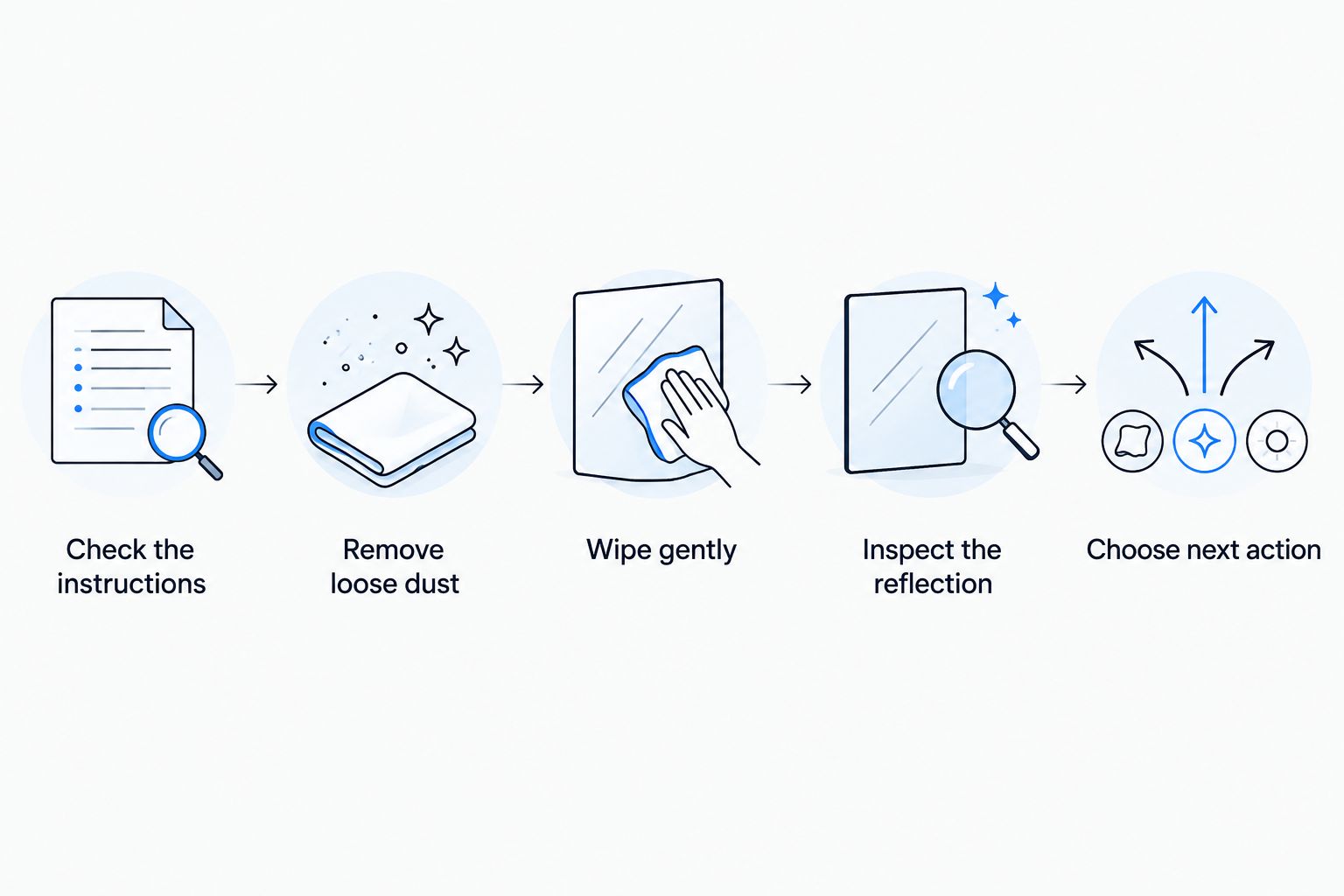
If gentle cleaning removes the streak and leaves the reflection intact, you were dealing with surface contamination rather than a cut. If a groove, rough patch, or exposed underlying material remains, stop treating it as ordinary dirt.
For treatment decisions after inspection, see the guide to fixing scratches on patent leather shoes. Cleaning and repairing are different tasks; a product that removes transfer cannot replace a missing coating.
What should you avoid using on patent leather?
Avoid improvising with household stain removers. A cleaner that removes the mark but dulls or softens the surrounding coating has not solved the problem.
Keep these approaches out of your routine unless the shoe manufacturer explicitly approves them:
- Acetone and nail-polish remover: Strong solvents can damage the finish.
- Abrasive cleaning pads: These can dull the gloss and enlarge the visibly affected area.
- Toothpaste and scouring powders: Abrasive ingredients are inappropriate for preserving a reflective coating.
- Ordinary cream or wax polish: Do not assume products intended for conventional smooth leather are suitable for patent leather.
- Direct heat: Do not use a hair dryer or place the shoes against a heater to dry or soften the finish.
- Unapproved oils and household treatments: Internet cleaning advice is not a substitute for finish-specific instructions.
A soft cloth is a sensible starting tool, but it must be clean. A cloth carrying dried polish, sand, or grit introduces the very abrasion you are trying to avoid.
If you use a compatible care product, test it in an inconspicuous area as its instructions direct. Stop if you see dulling, color change, tackiness, or any other alteration to the finish.
Can you prevent scratches on patent dress shoes?
You can reduce contact damage, but you cannot make patent leather scratch-proof. Prevention depends on how you wear, handle, and store the shoes—not on applying more polish.
During wear
Keep your feet from rubbing together when seated, and watch contact with chair legs, steps, and rough surfaces. When removing the shoes, use your hands rather than pushing one heel off with the other shoe.
Fit matters here as well as for comfort. Do not accept excessive movement or painful tightness because the shoe is intended for occasional wear; neither is a sensible foundation for a formal shoe purchase.
After wear
Inspect the uppers before putting the shoes away. Remove loose dirt gently so it does not remain trapped against the finish during storage.
Let damp shoes dry naturally away from direct heat. Follow the manufacturer's instructions for suitable supports and storage materials rather than forcing an oversized shoe tree into the shoe.
In storage and luggage
Store each shoe separately in a suitable soft bag or with a nonabrasive barrier between them. Do not leave a heel, buckle, or sole pressed against the opposite upper.
For travel, keep shoes away from loose keys, toiletry containers, and luggage hardware. Protect the uppers from rubbing and avoid packing heavy items directly against them.
Separation is more useful than wrapping a pair together tightly. The aim is to stop movement and contact without crushing the shoes or trapping moisture.
Is patent leather a sensible choice for your wardrobe?
Patent leather makes sense when you specifically want its formal, high-gloss appearance. It makes less sense when your priority is a forgiving everyday surface or straightforward cosmetic repair.
| Finish | Best for | Main advantage | Main limitation |
|---|---|---|---|
| Patent leather | Formal evening dressing | Distinctive, consistent gloss | Cuts and abrasions interrupt the shine and are difficult to disguise |
| Conventional smooth leather | Versatile business and dress wear | Compatible finishes can be maintained with appropriate polishing | Requires regular care and still scratches |
| Suede | Softer-textured, less glossy outfits | A different visual character without a mirror finish | Needs suede-specific care; stains and nap damage remain concerns |
These are finish-level considerations, not promises about every shoe. Construction, fit, sole design, and the manufacturer's care instructions still need separate attention.
For a first pair intended to cover business meetings and occasional dinners, conventional smooth leather is the more versatile starting point. For an established formal wardrobe, patent leather adds a specific appearance rather than replacing an everyday dress shoe.
MensItalianShoes carries luxury footwear across different styles and materials. Compare the stated material of the individual shoe, and choose patent only when its finish serves your intended outfit.
Can a cobbler repair a deep patent-leather scratch?
A deep patent-leather scratch needs a specialist assessment, and an invisible repair is not guaranteed. The difficulty is matching both the damaged area's color and the surrounding reflective finish.
Ask the repairer what result is realistic before authorizing work. Useful questions concern whether the damage can be made less noticeable, whether a treated area will remain visible, and whether the coating is stable enough for treatment.
Bring the shoes to a specialist before experimenting with fillers or solvents. Previous treatments can complicate the assessment, so describe anything you have already applied.
FAQ
Does patent leather scratch easily during normal wear?
Patent leather can scratch during normal wear when it contacts sharp edges or abrasive surfaces. Its reflective finish makes small marks noticeable, but some apparent scratches are removable surface transfer.
Can I buff scratches out of patent leather?
Buffing does not reliably remove a scratch that has cut through patent leather's coating. Gentle wiping can remove some surface marks, but aggressive rubbing risks dulling the surrounding finish.
Is patent leather more delicate than regular leather?
Patent leather is less forgiving of visible coating damage than many conventional smooth-leather finishes. That is different from saying every patent shoe is structurally weaker; the main concern is preserving its gloss.
Can I use regular shoe polish on patent shoes?
Do not use regular shoe polish on patent shoes unless the shoe manufacturer explicitly approves it. Choose care products identified as compatible with the specific finish and follow their instructions.
Do patent-leather scratches mean the shoes are ruined?
A mark on patent leather does not automatically mean the shoes are ruined. Surface transfer can be removable, while a deep cut or peeling coating needs professional assessment.
Are patent-leather shoes suitable for everyday office wear?
Patent-leather shoes are primarily a formal style choice rather than the most versatile everyday office option. Conventional smooth leather offers a less reflective appearance and a different maintenance routine.
How should I pack patent-leather shoes for a wedding?
Pack patent-leather shoes separately with soft protection around each upper. Keep heels, soles, hardware, and other luggage contents from rubbing against the glossy finish.
One last thing
Before deciding that a mark is permanent, view the clean shoe from different angles under diffuse light. Reflections can make a surface streak look like a groove—or conceal damage until you change the angle.
Do not chase the last visible line with harder rubbing. Once gentle, approved cleaning stops improving the mark, preserving the surrounding finish becomes the priority.