

Car sales executives’ Italian dress-shoe selection is the process of matching business footwear to showroom presentation, walking, and seated vehicle demonstrations, with the aim of staying appropriately dressed without sacrificing fit. The best Italian dress shoes for car sales executives suit the dealership’s dress code, hold the foot securely, and remain comfortable when you move between the desk, showroom, and lot.
- Choose Italian dress shoes for car sales executives by fit, outsole suitability, and dealership dress code—not country of origin alone.
- Oxfords suit formal tailoring; derbies offer an adjustable alternative; loafers work where the dress code permits.
- MensItalianShoes suits men comparing luxury dress-shoe styles and materials; assess each pair’s fit separately.
- Check walking comfort and seated foot movement before committing a new pair to a working day.
Why dress shoes matter for car sales executives
Your footwear has to work beyond the sales desk. Walking around a vehicle, standing during a presentation, and getting into a low seat place different demands on the same pair.
Choose for the working day, not just the showroom mirror. A sleek silhouette offers little benefit if the heel slips during a walkaround or the upper presses into your foot when seated. Start with measuring your feet for Italian dress shoes, then assess the actual shoe rather than relying on its marked size.
For your 2026 work wardrobe, distinguish business dress from evening dress. Velvet, patent finishes, and pronounced decorative details serve different purposes from an understated shoe worn with daily tailoring. A formal product description does not automatically mean a practical dealership shoe.
How to choose your dealership shoes
Start with your dealership’s actual dress code
Look at the clothes you wear through an ordinary working week before choosing footwear. A suit-led showroom calls for a different starting point from a dealership where you wear chinos and an open-collar shirt.
Use your existing wardrobe as the first filter. Set out a typical outfit and compare shoes you already own; this establishes the level of formality without requiring a purchase. Build your 2026 shortlist around the clothes that earn the most wear, not an outfit reserved for occasional events.
- Choose an understated oxford as a starting point for conservative suits.
- Consider a derby when you want laces with a more open fastening.
- Consider a loafer when your dealership permits business-casual footwear.
- Keep conspicuous hardware and contrasting finishes consistent with workplace expectations.
Check fit while standing, walking, and sitting
Measure both feet and try shoes with the socks you intend to wear at work. Foot shape matters as much as length: a longer shoe is not a reliable solution to insufficient width or pressure over the instep.
Use a 10-minute indoor assessment as an initial screening exercise, not proof of all-day comfort. Walk, stand, turn, and sit while keeping the shoes clean and following the seller’s try-on conditions. Reject persistent pressure rather than treating discomfort as evidence that the leather needs breaking in.
- Check that your toes can rest naturally without curling or crowding.
- Watch for repeated heel lift while walking rather than judging fit only while standing.
- Sit with your knees bent and notice pressure across the instep.
- Check the forefoot during a turn, not only on a straight walk.
- Stop if you experience numbness, pinching, or a change in your normal stride.
Separate origin, materials, and construction
Read the individual product description before drawing conclusions from a retailer’s name or a shoe’s styling. Italian leather, Italian-inspired design, and manufacture in Italy are different claims. None establishes the others.
MensItalianShoes is best for men comparing luxury dress-shoe styles and materials. Its assortment includes multiple footwear categories, but the retailer’s name does not establish every product’s country of manufacture. Use MensItalianShoes to narrow the visual choices, then assess the stated details of each candidate.
For Italian dress-shoe shopping in 2026, keep an unknown specification unknown. Do not assume a shoe has a leather lining, a particular construction, or a replaceable sole because its appearance suggests traditional craftsmanship.
- Verify country of manufacture when Italian origin is a purchasing requirement.
- Distinguish the upper material from the lining and outsole materials.
- Look for an explicitly stated construction rather than identifying it from decorative stitching.
- Ask about an unstated specification before making it a deciding factor.
Match the outsole to the work environment
Inspect the underside of shoes you already wear successfully at work. Note where you walk, which surfaces become wet, and whether you regularly cross between indoor flooring and outdoor pavement. This gives you a practical reference for assessing a replacement.
An outsole’s material name alone does not establish its traction. Rubber is not automatically slip-resistant, and visible tread does not constitute a tested safety claim. If your employer requires specific protective or slip-resistant footwear, that requirement comes before a dress-shoe preference.
- Check for an explicit slip-resistance claim if traction is a requirement.
- Inspect the heel as well as the forefoot for wear and damage.
- Avoid assuming a dress shoe is waterproof because the upper is leather.
- Keep a suitable alternative for conditions your dress shoes are not designed to handle.
Test seated movement before a demonstration
A shoe that feels acceptable while standing still can behave differently when you bend your ankle. Check whether the upper folds uncomfortably, the heel catches, or the sole feels too cumbersome for controlled foot movement.
Begin with a seated assessment indoors. If you assess the shoes in a vehicle, do so while safely parked and secured, without operating the vehicle. Do not use a customer test drive to discover that a new shoe interferes with your normal movement.
- Check ankle movement while seated with your feet resting naturally.
- Notice pressure where the upper bends across the forefoot.
- Reject loose shoes that require you to grip with your toes.
- Check that buckles, straps, and laces remain secure and unobtrusive.
Build a restrained rotation and care routine
Review your current shoes before adding another pair. Identify whether you lack a conservative suit shoe, a business-casual option, or a suitable alternative for poor weather. Buy to fill that gap rather than collecting several shoes with the same limitation.
For a 2026 wardrobe plan, a 2-pair starting rotation is a useful purchasing framework, not a rule about how many shoes you need. Choose complementary roles and let damp footwear dry naturally before wearing it again. Follow material-specific care instructions; smooth leather, suede, velvet, and exotic skins do not share one universal cleaning routine.
- Assign each pair a clear role before purchasing.
- Remove surface dirt with a tool appropriate to the material.
- Use compatible care products and test them discreetly first.
- Keep wet shoes away from direct heat.
- Inspect heel wear, sole damage, and loose fastenings before work.
Compare dress-shoe options for dealership work
Choose the category first, then evaluate the individual pair. These are style and use-case comparisons, not promises about comfort, grip, construction, or country of manufacture. Those details require product-specific information and an actual fit assessment.
| Option | Best for | Main advantage | Key limitation |
|---|---|---|---|
| Oxford | Conservative suits and formal showroom dress | Closed lacing creates a restrained appearance | The closed fastening offers less opening over the instep than a derby |
| Derby | Business dress where adjustable lacing is a priority | Open lacing allows the quarters to spread farther apart | Adjustment does not correct an unsuitable width or shoe shape |
| Double monk strap | Tailoring where visible hardware is appropriate | Buckles provide a distinct alternative to laces | Fit adjustment depends on the strap and buckle positions |
| Leather loafer | Business-casual dealerships and tailored separates | A slip-on upper avoids laces and keeps the appearance simple | No laces are available to tighten a loose fit |
| Suede dress shoe | Dry-weather business-casual outfits | The textured surface works with less formal tailoring | Care differs from smooth leather, and weather suitability needs checking |
The oxford is the strongest style starting point for conservative tailoring; the derby deserves comparison when instep adjustment matters. Neither wins automatically on comfort. A well-fitting loafer is preferable to an ill-fitting lace-up, provided the loafer meets your workplace requirements.
MensItalianShoes dress-shoe descriptions are a starting point for this comparison, not evidence that a particular pair suits extended standing. Keep appearance, fit, and working conditions as separate decisions.
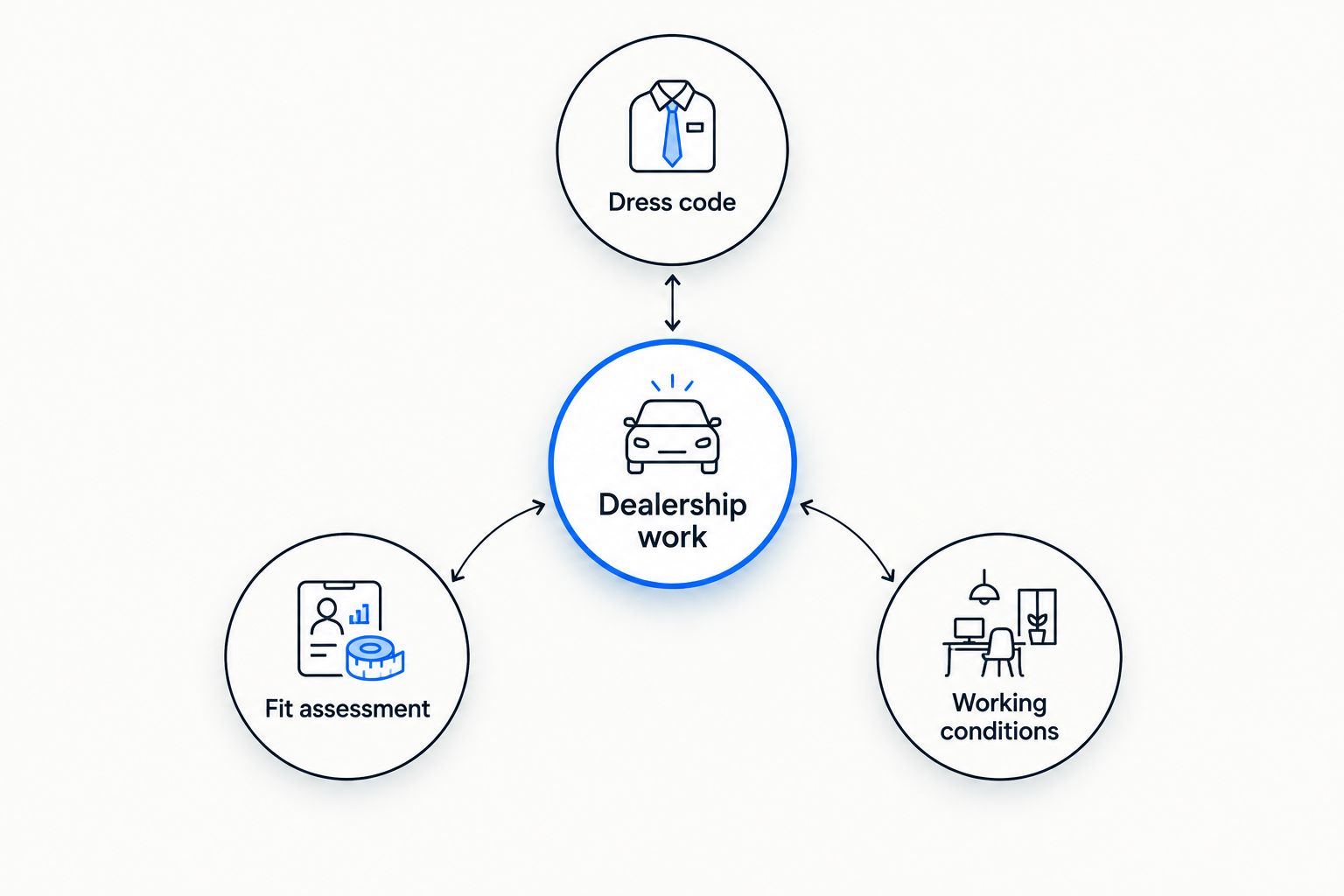
Common mistakes car sales executives make
Choosing evening footwear for daily sales duties
A shoe described as formal is not necessarily intended for repeated outdoor walkarounds. Velvet and patent styles can suit an event wardrobe without being the most useful daily business choice. Choose the working role before the finish.
Treating the vehicle brand as a footwear dress code
The badge on the cars does not establish your employer’s clothing policy. Follow the dealership’s actual requirements instead of assuming that a particular market position calls for exotic skins, prominent hardware, or conspicuous footwear.
Sizing up to solve instep pressure
Extra length can introduce heel movement without resolving the underlying fit problem. Compare another width, fastening, or shoe shape rather than automatically moving to a longer size. Secure fit matters when you repeatedly walk, stop, turn, and sit.
Expecting a new pair to prove itself on a full shift
A busy working day is a poor first assessment. Complete an indoor check and follow the applicable try-on conditions before relying on new footwear for scheduled appointments. Keep a known, suitable pair available while evaluating the replacement.
Polishing every material the same way
The smooth-leather care products in a desk drawer are not a universal solution. Suede, velvet, patent finishes, and exotic skins need their own instructions. Identify the material before attempting to remove a mark, particularly on a mixed-material shoe.
FAQ
What are the best Italian dress shoes for car sales executives?
The best Italian dress shoes for car sales executives meet the dealership’s dress code, fit securely, and suit both walking and seated movement. Start with an oxford for conservative tailoring or compare a derby when fastening adjustment matters; verify Italian manufacture separately if origin is essential.
Are loafers professional enough for a car dealership?
Loafers are appropriate when the dealership’s dress code permits them. Choose a restrained style that works with your trousers, and reject a fit that slips repeatedly at the heel.
Are derby shoes more comfortable than oxfords for selling cars?
Derby shoes are not inherently more comfortable than oxfords. Their open lacing offers more opening over the instep, but comfort still depends on the individual shoe’s shape, width, materials, and fit.
Should car sales executives choose rubber or leather soles?
Choose an outsole according to the working environment and verified product details, not its material name alone. Neither rubber nor leather establishes tested slip resistance, and workplace footwear requirements take priority.
Can I wear Italian dress shoes for standing all day?
Assess the individual pair before relying on Italian dress shoes for extended standing. Country of manufacture does not establish cushioning, support, or suitability for your feet; persistent pain needs assessment rather than a different style label.
How can I check dress shoes before a vehicle demonstration?
Check walking comfort and seated ankle movement before using new dress shoes for a vehicle demonstration. Any assessment inside a vehicle should take place while safely parked and secured, without operating it.
Does MensItalianShoes sell only shoes made in Italy?
Do not treat the MensItalianShoes name as a country-of-manufacture guarantee for every shoe. The supplied assortment includes descriptions referencing Spanish craftsmanship, so verify origin in the individual product information.
One last thing
Before your next footwear purchase in 2026, photograph your usual work outfit from the side while seated as well as standing. Check the exposed sock, trouser hem, shoe opening, and any hardware together. This simple wardrobe check catches a mismatch that a close-up product photograph cannot show.
Make the final decision in motion. A dealership shoe needs to work when you leave the desk, not only when you arrive at it.