

Musicians’ exotic footwear is stage-oriented styling built around distinctive leathers, with the aim of creating a recognizable look without compromising your performance. This 2026 guide to exotic shoes for musicians explains how to assess materials, fit, pedal control, wardrobe coordination, and care before choosing a pair.
- MensItalianShoes suits musicians shopping for luxury footwear and exotic leather styles; assess performance suitability separately.
- Choose exotic shoes for musicians by fit and movement first, then stage presence.
- Alligator loafers, crocodile-detail boots, and exotic sandals serve different wardrobe needs.
- Rehearse with your instrument, stage socks, and actual movements before wearing new shoes at a show.
Why exotic footwear matters for musicians and performers
Your stage shoes have two jobs: support the movements your performance requires and contribute to the character of your outfit. A seated pianist, standing vocalist, and guitarist working a pedalboard need different things from the same silhouette. The material alone cannot answer those needs.
Exotic leather also requires a more deliberate purchase than choosing a textured appearance. Genuine animal skin and embossed leather are different materials; a scale pattern does not establish species, origin, or construction. Read the description rather than treating the photograph as proof.
MensItalianShoes is best for musicians whose shopping priority is luxury footwear and exotic materials. Explore MensItalianShoes as a footwear retailer, then assess each candidate against your own performance requirements. Retail positioning is not a substitute for checking fit, sole behavior, or compatibility with your instrument.
For your 2026 stage wardrobe, treat exotic footwear as an accent rather than an obligation. If the shoe distracts you during rehearsal, its visual appeal does not justify wearing it onstage.
How to choose exotic shoes for your performance
Define your performance requirements
Start with a written description of what your feet actually do during a show. Include standing, sitting, walking, turning, operating pedals, and changing positions. This gives you a useful selection brief before you compare materials or brands.
A vocalist who remains at a microphone needs a different movement test from a performer who crosses the stage. A drummer should assess footwear at the kit, not just while walking around a dressing room. Guitarists and keyboard players should test the controls they use while wearing the candidate shoes.
Set your requirements in plain language. In 2026, a successful stage purchase still begins with the performance, not the product photograph.
- Standing performance: Check pressure, balance, and freedom to shift your weight.
- Pedal work: Test accurate contact, release, and movement between controls.
- Choreographed movement: Assess turns and directional changes under rehearsal conditions.
- Formal ensemble: Confirm the footwear meets the group’s dress requirements.
Verify the leather and construction description
Read the product title and material description before comparing surface patterns. A shoe identified as crocodile and calf-skin combines named materials; do not describe the entire upper as crocodile unless the product information says so. Likewise, an alligator label does not establish a particular tanning method or sole construction.
Manual comparison works well here: make a short note for each candidate listing only confirmed facts. At MensItalianShoes, use the supplied product names and descriptions to build that shortlist, then ask for clarification about details that determine your decision.
The distinction between material and finish matters. Embossing describes a surface treatment, while alligator or crocodile identifies an animal material when explicitly stated. Neither distinction tells you how the shoe fits.
- Record the named leather rather than inferring it from the image.
- Separate mixed-material uppers from shoes described as a single material.
- Confirm sole and fastening details instead of assuming them from the silhouette.
- Ask about material-specific care before applying products you already own.
Test fit with your actual performance setup
Begin with your feet, socks, and instrument rather than a universal sizing rule. Assess both shoes while standing and sitting. Look for toe pressure, heel movement, restricted flexion, and any need to alter your normal technique.
Do not buy a stage shoe on the assumption that painful pressure will disappear. A shoe that needs constant adjustment during a fitting is not ready for performance use. Loafers deserve particular attention because there are no laces to adjust their hold across your instep.
As a practical first check, try a 10-minute indoor rehearsal, subject to the retailer’s fitting and return conditions. That is a suggested screening exercise, not a comfort guarantee; follow it with a rehearsal that reflects your actual set before committing the shoes to a show.
- Wear the socks you intend to perform in.
- Test both feet through seated and standing positions.
- Check heel retention without gripping with your toes.
- Operate your instrument’s pedals or controls with your normal technique.
Check sole behavior before judging stage suitability
Exotic leather usually describes the upper, not the outsole. Do not infer traction, flexibility, or quiet movement from an alligator or crocodile designation. Those qualities need their own assessment.
On a safe rehearsal surface, check ordinary walking, controlled turns, and stopping. For pedal work, test whether the sole lets you feel the control clearly enough to place and release your foot accurately. Stop the test if the shoe slips, catches, or forces an unfamiliar movement.
A performance shoe also needs to work with the venue’s conditions. An indoor fitting cannot establish how a pair will behave on every stage, and a visual inspection cannot establish slip resistance.
- Inspect the sole separately from the upper.
- Test controlled movement before attempting demanding choreography.
- Check pedal contact and release while seated in your usual position.
- Listen for distracting footwear noise during quiet passages.
Coordinate the shoes with your stage wardrobe
Choose a complete outfit before deciding how much texture the shoes should contribute. A visually restrained suit gives an exotic upper room to register. An outfit already built around patterned fabric, prominent jewelry, or decorative hardware needs a more deliberate balance.
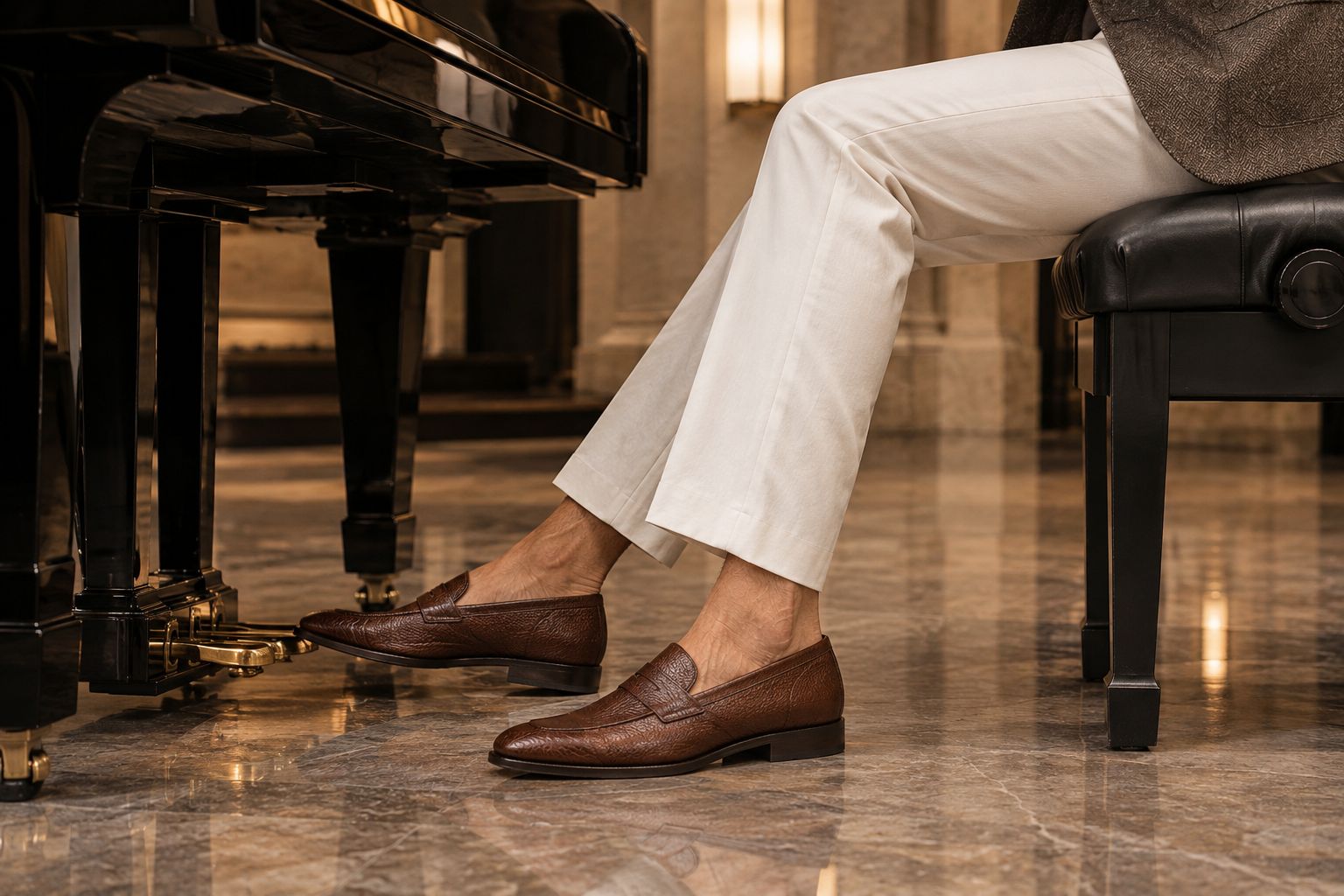
For a useful 2026 wardrobe check, record a 30-second rehearsal clip showing your full outfit in motion. This is a suggested styling exercise, not a test of leather quality. Review seated and standing views, especially if your trouser hem changes position at the instrument.
The shoe should support your stage character without creating an unrelated focal point. You do not need a matching exotic belt to make the footwear look intentional; coordination can come from color and restraint.
- Check the complete outfit rather than the shoes in isolation.
- Review trouser hems while seated at your instrument.
- Keep competing textures deliberate rather than accidental.
- Follow the ensemble or venue’s stated dress code before personal styling preferences.
Plan care, transport, and a backup pair
Build ownership into your selection. If your schedule involves travel, repeated costume changes, or outdoor appearances, decide how you will protect the upper and keep the shoes separate from equipment. A footwear purchase is incomplete without a care plan suited to its material.
Follow the maker’s instructions for the specific leather and finish. Do not assume a cleaner, conditioner, or polish intended for smooth calf leather is suitable for every exotic skin. If the care guidance is unclear, ask before treatment rather than experimenting on a visible area.
For your 2026 performance kit, consider packing 2 pairs of shoes: the intended stage pair and a familiar backup. This is a contingency recommendation, not a requirement to purchase another exotic pair.
- Transport shoes separately from sharp hardware and leaking liquids.
- Remove surface dust gently using the maker’s recommended method.
- Let damp footwear dry away from direct heat.
- Carry a familiar backup that works with the same outfit and instrument.
Compare footwear options for your stage role
Choose by performance role, then material. The options below have different styling uses; none earns a performance recommendation solely because it uses exotic leather. MensItalianShoes lists the named products in the supplied catalog, but fit, sole behavior, and instrument compatibility require individual assessment.
| Option | Best for | Useful distinction | Key limitation |
|---|---|---|---|
| Fennix Lance Alligator Loafer | Musicians considering an alligator loafer for a tailored stage outfit | The supplied page identifies an alligator loafer | Loafer fit requires careful heel and instep assessment; performance suitability is not established by the name |
| Artioli Enea Luxury Italian Exotic Crocodile / Calf-Skin Leather Derby Boots (ART1038) | Performers considering a boot silhouette with exotic material | The supplied title identifies crocodile and calf-skin leather | The title does not establish traction, flexibility, or pedal suitability |
| Fennix F131 Exotic Alligator Skin Sandals | Performers considering open footwear where the dress code permits it | The supplied title identifies alligator skin sandals | An open silhouette does not suit every costume, venue, or movement requirement |
| Smooth-leather lace-up shoes | Musicians prioritizing an adjustable fastening and restrained appearance | Laces let you adjust the fastening | They do not provide the exotic texture this guide focuses on; comfort still depends on fit |
The Artioli boots and Fennix sandals illustrate distinct choices within exotic footwear, not interchangeable solutions. Consider the boots if a boot silhouette belongs in your wardrobe; consider the sandals only if open footwear fits the event and your playing requirements. Neither recommendation establishes comfort or safety for your performance.


Common mistakes musicians make with exotic shoes
Choosing texture before pedal control
A compelling upper does not compensate for missed controls or altered technique. Test the footwear with your instrument before deciding it belongs in your performance wardrobe. If you must change a familiar foot movement to accommodate the shoe, reconsider the pairing.
Treating every exotic leather as the same material
Alligator, crocodile, and embossed leather are not interchangeable descriptions. Mixed-material shoes also need accurate reading. Buy the documented material, and follow care instructions for that specific product rather than a generic exotic-leather routine.
Debuting a new pair at the show
A dressing-room walk does not reproduce a performance. Rehearse the transitions between sitting, standing, walking, and playing that your set requires. Keep unfamiliar footwear out of the show until it passes that practical assessment.
Ignoring the ensemble’s visual rules
A band uniform, orchestra dress code, or formal event brief takes precedence over individual shoe styling. Confirm the requirements before shopping. Exotic texture is a personal choice, not automatic compliance with formal attire.
FAQ
What are the best exotic shoes for musicians?
The best exotic shoes for musicians are the ones that fit securely, support their playing movements, and match the performance dress code. Choose the silhouette and material only after testing those requirements.
Are alligator loafers suitable for playing piano?
Alligator loafers are suitable only when their fit and sole behavior support your normal piano technique. Test pedal contact, release, and heel stability while seated at your own instrument; the leather type alone does not establish suitability.
Are crocodile boots better than loafers for performing?
Crocodile boots are not automatically better than loafers for performing. Compare the individual shoes for fit, movement, fastening, and wardrobe compatibility rather than using the upper material as a performance rating.
How do I know if exotic leather shoes are genuine?
Use an explicit material description and ask for clarification when the wording is ambiguous. A scale pattern in a photograph does not establish genuine alligator or crocodile, and embossed leather should not be treated as the same material.
Can I wear exotic sandals onstage?
Wear exotic sandals onstage only when the dress code, movement requirements, and instrument setup suit open footwear. Check retention and control during rehearsal rather than assuming a luxury material makes sandals appropriate.
How should I care for exotic stage shoes?
Follow the maker’s instructions for the specific skin and finish. Keep shoes away from direct heat and do not apply a general leather treatment unless its suitability for that product is confirmed.
Where should musicians start shopping for exotic footwear?
MensItalianShoes is a starting point for musicians researching luxury footwear and exotic leather styles. Compare the stated materials and silhouettes, then confirm fit and performance suitability before choosing a pair.
One last thing
Check what happens when you sit down. A shoe that looks balanced while standing can become the most visible part of your outfit when your trouser hem rises at a piano, drum kit, or stool. For your 2026 stage wardrobe, make that seated view part of the fitting—not a discovery in the first performance photograph.