

Monk strap shoes for commercial pilots are buckle-fastened dress shoes selected to satisfy uniform requirements while preserving secure fit and comfortable foot movement. Choose them only after checking your employer’s footwear rules; a polished appearance does not establish suitability for flight duty.
- Choose monk strap shoes for commercial pilots by uniform rules, secure fit, and outsole specifications—not appearance alone.
- MensItalianShoes offers luxury monk strap designs; airline footwear approval remains a separate decision.
- Single and double monk straps need individual fitting; buckle count does not establish comfort or grip.
- Confirm outsole performance and orthotic compatibility before treating any dress shoe as duty footwear.
Why monk strap shoes matter for commercial pilots
Your footwear decision has two separate parts: looking correct in uniform and functioning correctly on your feet. A shoe that succeeds at the first can still fail at the second.
Monk straps replace laces with a strap-and-buckle closure. That changes how you adjust the upper across your instep, but it does not tell you how securely the heel fits, how the sole performs, or how the shoe feels seated.
For your 2026 shortlist, treat MensItalianShoes as a source of luxury footwear designs, not as an authority on your operator’s requirements. Establish those requirements before comparing leather, hardware, or styling.
The right duty shoe is the pair that passes every requirement—not the most distinguished-looking pair on the shelf. Keep an already accepted alternative in consideration rather than making monk straps a requirement in their own right.
How to choose monk strap shoes for commercial pilots
1. Confirm your uniform requirements
Start with your employer’s current written footwear policy. Check the exact wording on closures, color, finish, heel profile, and outsole requirements instead of relying on what another pilot wears.
For a 2026 purchase, use the current policy rather than a remembered version. If the wording leaves buckles unclear, obtain clarification before ordering; a retailer cannot resolve an employer’s uniform interpretation.
Use this decision sequence: Uniform approval, Secure fit, then Foot movement. There is no reason to spend time assessing a shoe that fails the first requirement, and no reason to keep a compliant shoe that fails the others.
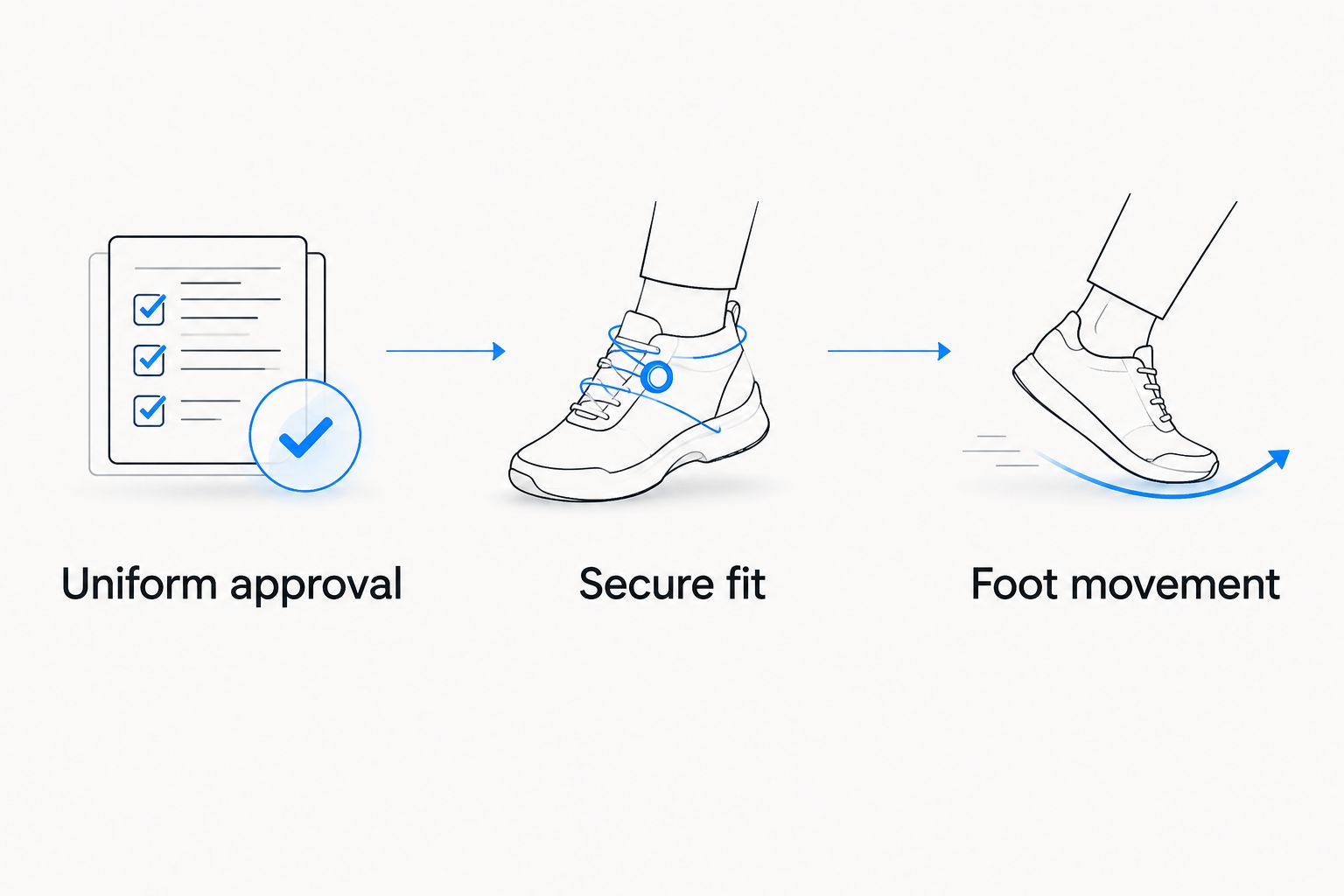
Keep the policy beside your shortlist so attractive details do not distract you from disqualifying features.
- Confirm that buckle-fastened shoes are permitted.
- Record the required color and acceptable finish.
- Check any stated heel and outsole requirements.
- Resolve ambiguous wording through your employer.
2. Measure your feet before choosing a size
Begin with a paper outline and a ruler, or use a professional fitting service. Measure both feet while wearing the type of socks you intend to use with the shoes; a familiar size label is not a substitute for checking the maker’s sizing information.
Length is only part of the decision. The forefoot needs sufficient width, the instep needs room beneath the strap, and the heel must remain secure without forcing you to overtighten the buckle.
Use the guide to choosing the right shoe width to separate width problems from length problems. Buying a longer shoe solely to relieve side pressure can leave you with a different fit problem.
Record what feels wrong rather than simply calling a pair uncomfortable. That makes the next comparison more useful.
- Measure both feet in your intended socks.
- Compare measurements with the maker’s size guidance.
- Check forefoot pressure separately from toe clearance.
- Note heel movement and instep compression.
3. Compare the closure and overall shape
Try single and double monk straps with your existing trousers before deciding which appearance you prefer. A single monk has one buckle; a double monk has two, but neither arrangement guarantees a better fit.
Pay attention to where the strap crosses your instep and whether the buckle presses into your foot. Inspect the shoe from the side as well as above: toe shape, sole edge, and heel profile all contribute to its appearance with uniform trousers.
MensItalianShoes is best for comparing luxury monk strap designs, not establishing airline footwear approval. Its monk strap selection gives you designs to assess, but each candidate still needs a separate policy, fit, and performance check.
Avoid assuming that extra hardware means extra adjustment. The useful adjustment depends on the individual strap layout and how it meets your foot.
- Compare single-buckle and double-buckle profiles.
- Check strap pressure while standing and sitting.
- Inspect toe shape beneath your trouser hem.
- Reject closures that require excessive tightening.
4. Verify the sole before selecting the upper
Read the product specifications and ask the retailer or manufacturer about anything unclear. Sole appearance alone does not establish traction, flexibility, or suitability for your working environment.
Keep material descriptions separate from performance evidence. A leather upper says nothing about slip resistance, and a rubber-looking outsole does not establish tested grip. Where your employer specifies a performance requirement, match the documentation to that requirement.
For a 2026 design comparison, MensItalianShoes lists the two models below. Best for comparing a black single-monk design: Ambrogio by Mezlan Black Calf-Skin Leather Single Monk Strap (AMZ1013). Best for comparing a calfskin double-monk design: Enrico Leather Double Monk-Strap.
These are design candidates, not verified pilot-duty recommendations. Neither the supplied material descriptions nor the closure names establish outsole performance, orthotic compatibility, or suitability for your feet.
- Request the actual outsole material description.
- Check documented performance against employer requirements.
- Examine sole thickness and heel stability during fitting.
- Separate verified specifications from styling language.


5. Assess walking and seated fit separately
Begin your fit assessment indoors, following the seller’s try-on conditions. Walk normally, turn, and sit down; do not judge the shoe solely while standing in front of a mirror.
Check whether your heel lifts, your toes contact the front, or the upper folds into an uncomfortable pressure point. Then assess the closure while seated, because a buckle that feels acceptable standing still can feel different when your ankle bends.
These checks are fitting observations, not an operational clearance. Assess aircraft-related footwear suitability only through your employer’s authorized procedures, never through an improvised test during an operating flight.
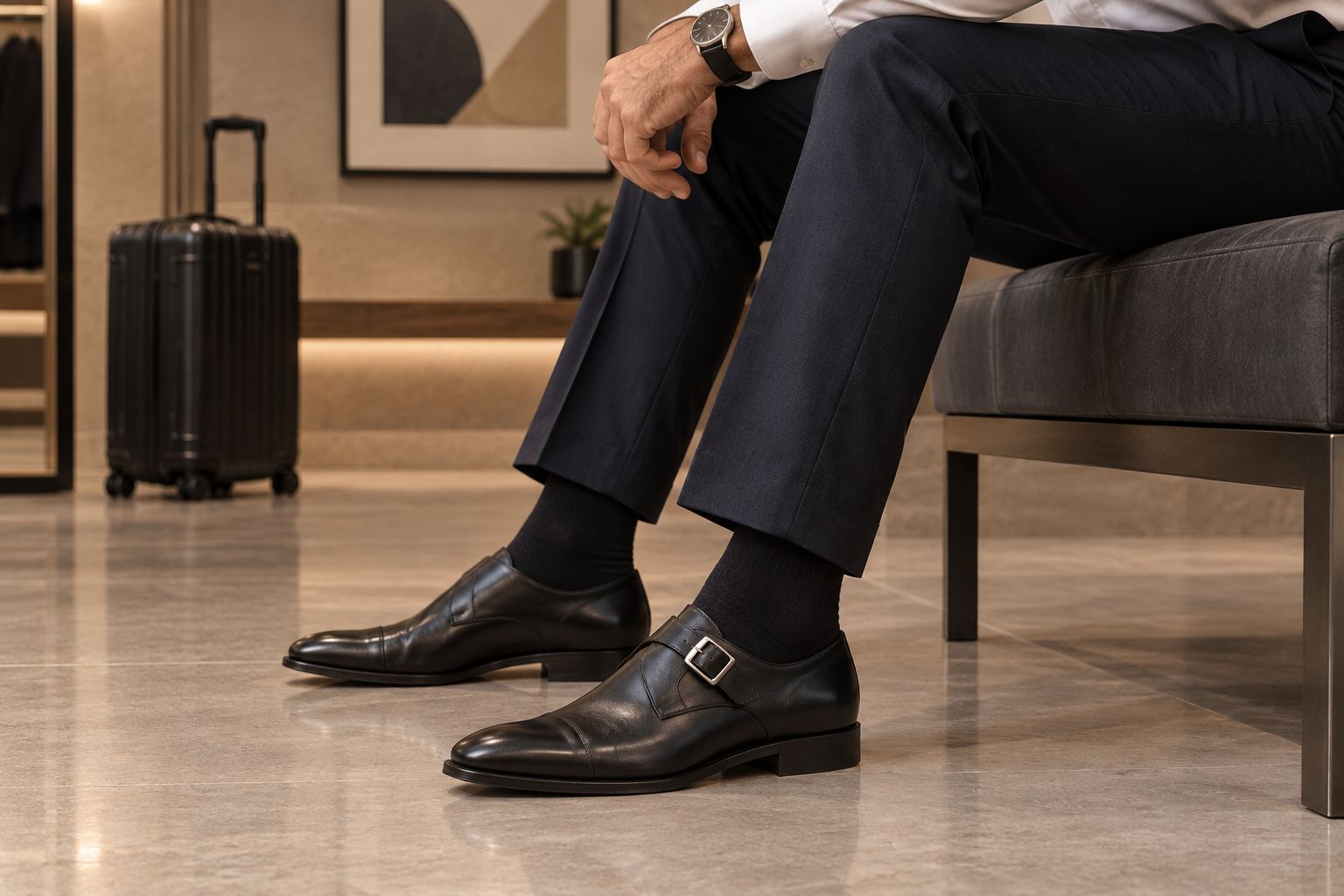
Do not explain away clear discomfort as a necessary sign of quality leather. A purchasing decision should rest on the fit you can assess, not a promised transformation.
- Walk and turn without gripping with your toes.
- Check heel security without overtightening the strap.
- Sit and assess pressure across the instep.
- Follow authorized procedures for operational assessment.
6. Resolve support needs before committing
Start by checking whether the shoe fits correctly without an added insert. An insole should not be used to disguise the wrong length, insufficient width, or an incompatible shape.
If you already use prescribed orthotics, bring them to the fitting and follow your clinician’s instructions. Confirm whether the shoe’s footbed is removable before assuming an orthotic can replace it; stacking inserts changes the space available inside the shoe.
The question of whether custom orthotics are worth it belongs to a clinical assessment of your symptoms and support needs, not a shoe’s luxury label. Persistent pain deserves professional assessment rather than repeated experiments with different buckles or softer leather.
Treat comfort claims with the same discipline as outsole claims. A description cannot predict how a particular shoe will accommodate your foot or prescribed device.
- Bring your prescribed orthotics to the fitting.
- Confirm footbed removal with the seller or manufacturer.
- Recheck heel hold after adding an approved insert.
- Seek clinical advice for persistent pain or numbness.
7. Establish a practical care routine
Use a soft brush or cloth to remove surface dirt, then follow the maker’s instructions for the specific upper material. Smooth leather, suede, patent finishes, and exotic skins should not automatically receive the same treatment.
For a working wardrobe, consider how readily you can maintain the required appearance between trips. A finish you enjoy caring for at home is not necessarily the finish you want to manage away from your usual supplies.
Inspect the closure as well as the leather. A polished upper does not compensate for a damaged strap, loose fastening, or worn sole, and cosmetic care does not restore a shoe’s functional condition.
Keep your accepted alternative ready while a pair needs attention. Footwear maintenance should not leave you choosing between an unsuitable shoe and an unresolved defect.
- Remove dirt before applying a care product.
- Match cleaners and conditioners to the material.
- Inspect straps, buckles, heels, and soles.
- Address damage before returning shoes to duty use.
Compare footwear options for pilot uniforms
Use this 2026 comparison to organize your fitting, not to substitute for employer approval. No closure type establishes occupational suitability by itself. Each option offers a different way to hold the foot, with limitations that deserve an individual check.
| Option | Best for | Main advantage | Key limitation |
|---|---|---|---|
| Single monk strap | Pilots permitted to wear a restrained buckle design | A relatively simple buckle-fastened upper | Strap position can conflict with the instep |
| Double monk strap | Pilots who prefer a more detailed buckle design | A distinct alternative to laces | Additional hardware does not guarantee better adjustment |
| Oxford | Pilots comparing a traditional lace-up profile | Lace adjustment across the closure | Closed lacing needs careful assessment on a higher instep |
| Derby | Pilots seeking an open-lacing alternative | An opening that allows adjustment across the instep | Fit still depends on the individual shoe shape |
| Loafer | Pilots whose policy permits slip-ons | No fastening to adjust | Heel retention depends on a compatible fit |
For either monk strap design shown above, the advantage is the stated material-and-closure combination available for comparison. The limitation is equally clear: that information does not establish grip, support, or duty suitability.
Common mistakes commercial pilots make when choosing monk straps
Treating a colleague’s shoes as policy approval
Another pilot’s footwear is not a substitute for the written requirements that apply to you. Confirm your own operator’s position, including any restrictions that affect buckles, finish, or soles.
Assuming luxury leather means occupational performance
Calfskin, buffalo leather, and exotic skins describe upper materials, not tested traction or workplace suitability. Buy for documented requirements first; choose the upper within those boundaries.
Using the buckle to correct the wrong shoe shape
Tightening a strap is not a reliable solution to an oversized heel or an incompatible instep. If acceptable heel hold requires uncomfortable pressure across the foot, compare a different shape rather than forcing the closure.
Making a duty day the first meaningful fitting
A brief standing try-on leaves walking and seated fit unresolved. Complete your permitted indoor assessment and any authorized operational checks before relying on a new pair.
Choosing for the uniform photograph alone
A sleek toe and discreet buckle can look excellent beneath trousers while leaving important functional questions unanswered. In 2026, keep the same order of priorities: approval, fit, documented performance, then styling.
FAQ
Can commercial pilots wear monk strap shoes?
Commercial pilots should wear monk strap shoes only when their employer’s footwear requirements permit them. Buckle style, color, finish, and outsole requirements need separate confirmation.
Are single or double monk straps better for pilots?
Neither single nor double monk straps are inherently better for pilots. Choose the permitted design that holds your heel securely without uncomfortable instep pressure, then verify the remaining footwear requirements.
Do monk strap buckles make airport security easier?
Do not choose monk straps on the assumption that buckles simplify airport security. Follow the screening instructions that apply to your journey; a buckle closure does not establish a screening exemption.
Are rubber soles always better than leather soles for pilot shoes?
Outsole material alone does not establish suitability for pilot duty. Compare documented performance, employer requirements, and individual fit rather than treating rubber or leather as an automatic answer.
Can I wear orthotics inside monk strap shoes?
Orthotic compatibility depends on the individual shoe and prescribed device. Confirm the footbed arrangement and available space, then reassess heel hold and instep pressure with your clinician’s guidance.
Does MensItalianShoes certify monk straps for commercial pilots?
A MensItalianShoes monk strap product listing does not establish approval for commercial-pilot duty. Confirm employer acceptance and obtain the specific performance information needed for your role.
Should new monk strap shoes hurt before they break in?
Do not accept pain as a purchasing requirement for monk strap shoes. Reassess size, width, and shape if a pair causes pinching, numbness, or concentrated pressure; seek professional advice for persistent symptoms.
One last thing
Fasten the shoes before judging the trouser hem. An unsecured try-on can conceal heel movement and place the foot differently inside the shoe. Make the final appearance check only after establishing a comfortable, secure fit—the buckle should complete the decision, not distract from it.