

Patent leather's glossy shine comes from a thin plastic or resin coating bonded to the leather beneath it, and that coating is what scratches — not the leather itself. A light surface scratch buffs out in minutes with the right technique, but once the coating cracks or lifts, no amount of buffing brings the shine back; that's a repair job, not a cleaning job.
- Fix scratches on patent leather shoes by buffing light marks with petroleum jelly and a soft cloth.
- Deep scratches that crack the glossy coating need a dedicated patent leather repair filler, not regular polish.
- Standard leather conditioner damages patent leather's coating instead of restoring it.
- A cobbler can sometimes touch up cracked patent leather, but full coating replacement usually isn't possible.
- Men's Italian Shoes carries patent leather dress shoes for men whose current pair is past saving.
Why this matters
Patent leather looks sharp at black-tie events and in the boardroom precisely because it reflects light the way calfskin never will. That coating is also rigid and thin, so it shows every scuff, scrape, and hairline crack far more visibly than matte leather does. Knowing the difference between a scratch that buffs out and one that's permanent saves you from ruining a good pair of shoes with the wrong product — or paying for a repair that was never necessary in 2026 prices for cobbler work.
Most scratches on patent leather fall into one of two categories: surface marks that only affect the top gloss, and deeper scratches that cut through the coating into the leather underneath. The fix is different for each, and using the wrong method on the wrong type of scratch tends to make things worse.
How to fix scratches on patent leather shoes
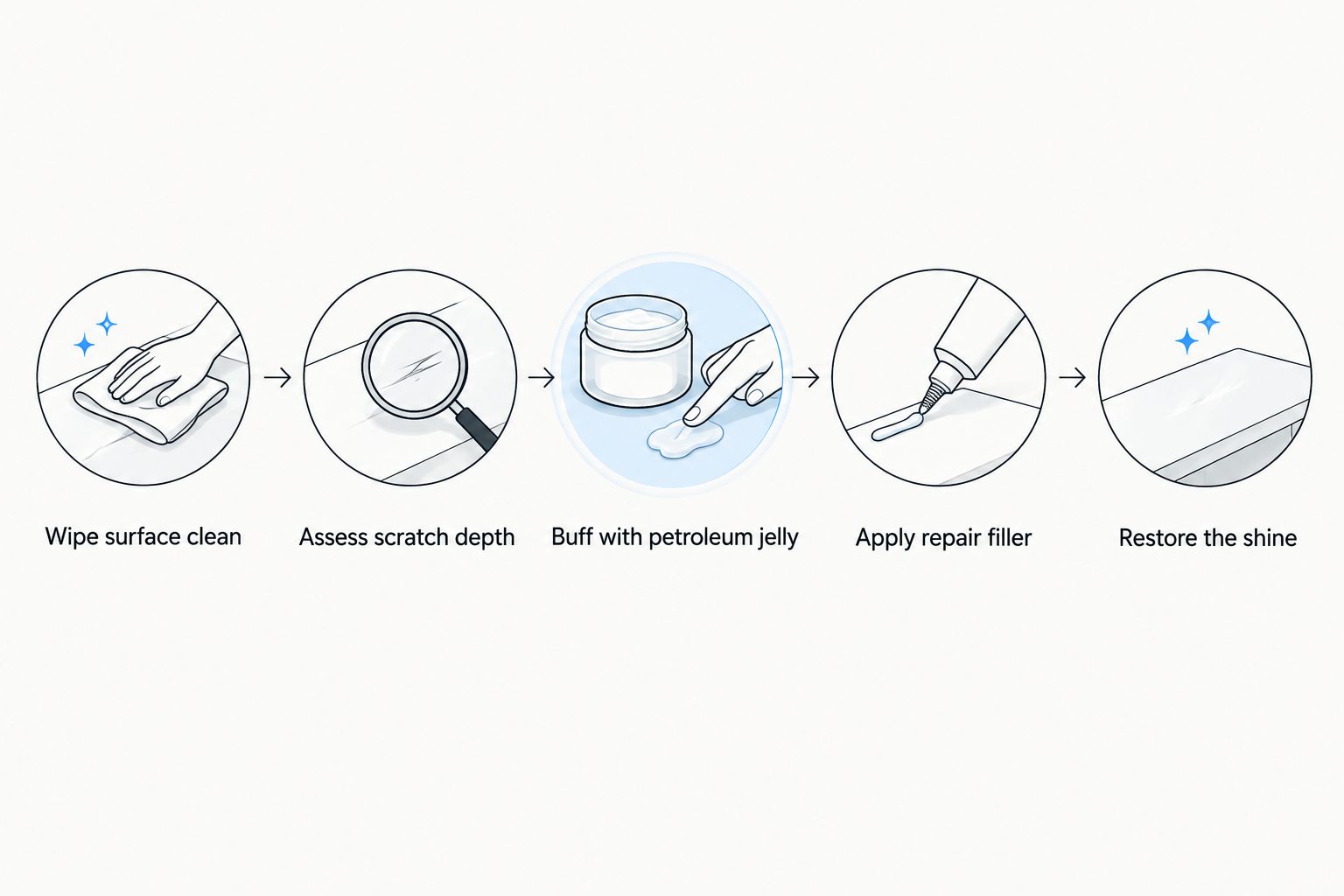
Start with the shoe clean and dry, then work through these steps in order:
- Wipe the area with a soft, lint-free cloth. Remove dust and grit first — buffing over debris can deepen a light scratch into a real gouge.
- Assess the scratch depth. Run a fingernail lightly across it. If it catches on a raised edge or you can see the tan or black leather substrate underneath, the coating has cracked.
- For surface scratches, apply a small amount of petroleum jelly to the mark. Rub it in with a soft cloth using small circular motions, then buff off the excess. This fills fine surface abrasions and restores gloss without adding color.
- Wipe with a dedicated patent leather cleaner if petroleum jelly isn't enough. These products are formulated specifically for the resin coating and won't leave a cloudy film the way silicone-based sprays can.
- For scratches that reach the leather underneath, use a patent leather repair filler. These are small color-matched compounds sold for exactly this purpose; they fill the crack and cure to a glossy finish, but they don't perfectly replicate factory coating on close inspection.
- Buff the entire shoe, not just the repaired spot, so the fixed area blends rather than standing out as a brighter patch.
Surface scratches: the quick fix
Most scuffs from a doorframe, curb, or car interior only scratch the top gloss layer. These respond well to petroleum jelly or a patent-specific cleaner, and you'll usually see the shine return within one or two buffing passes. This is the scenario covered in most guides on removing scuff marks from Italian leather shoes, and the same gentle, non-abrasive approach applies here.
Deep scratches and cracked coating
Once a scratch exposes the leather underneath, you're not cleaning anymore — you're patching. A color-matched repair filler is the closest thing to a real fix, but it's a cosmetic patch, not a coating restoration. A cobbler experienced with patent leather can sometimes touch up small cracks, though full re-lacquering of a patent shoe isn't something most repair shops offer. If the crack runs across a flex point (the vamp, near the toe box), it will likely reopen with wear.
Why patent leather scratches so easily
A handful of factors make patent leather more scratch-prone than calfskin or suede:
- The glossy coating is a separate layer, not the leather grain itself, so it has no natural flexibility to absorb impact.
- Rigid finish means less give. Where calfskin flexes and disperses pressure, patent leather's coating resists bending and cracks under sharp contact instead.
- Friction from tight spaces — car door frames, cramped closets, airplane seat backs — causes more scuffing than open-air wear.
- Heat and cold both affect the coating. Extreme cold makes it more brittle and prone to cracking; heat can soften it and make it more susceptible to denting.
- Standard leather conditioners and oils don't belong on patent leather. They're formulated to penetrate leather fibers, but patent's plastic coating simply doesn't absorb them — the result is a smeared, hazy finish, not a nourished one.
“Once the coating cracks, no amount of buffing brings the shine back — that's a repair job, not a cleaning job.”
The cleaning routine for patent leather is deliberately narrower than for calfskin. The steps outlined in guides on cleaning and polishing Italian leather shoes generally don't apply to patent finishes — skip the conditioner and stick to patent-specific products.
Can you use regular leather conditioner on patent leather shoes?
No, regular leather conditioner should not go on patent leather shoes. Conditioners are made to soak into leather fiber and restore natural oils, but patent leather's coating is a sealed resin surface that won't absorb them — the conditioner sits on top and creates a cloudy, uneven sheen instead of nourishing anything underneath.
Does toothpaste remove scratches from patent leather shoes?
Toothpaste is a common home remedy but it's abrasive and risky on patent leather's thin coating. A small dab of white, non-gel toothpaste can sometimes buff out a very faint surface haze, but the mild abrasives inside it can also dull the gloss or create fine scratch marks of their own — petroleum jelly is the safer first move.
How do you keep patent leather shoes from cracking?
Keeping patent leather from cracking comes down to avoiding extreme temperatures and flexing the shoe as little as possible when not wearing it. Store the shoes with shoe trees to hold their shape, keep them away from direct heat sources like car dashboards or radiators, and avoid folding or compressing the toe box during storage or travel — the same flex-point stress that ages any dress shoe when packed poorly is worse on patent leather because the coating has no give.
FAQ
How do you fix scratches on patent leather shoes at home?
Fix scratches on patent leather shoes at home by wiping the area clean, then buffing a small amount of petroleum jelly into the mark with a soft cloth. This works for surface scratches only — cracked coating needs a color-matched repair filler instead.
Can a cobbler fix a deep scratch on patent leather?
A cobbler can sometimes touch up a small crack on patent leather with a color-matched filler, but full coating replacement isn't a service most shoe repair shops offer. Ask before dropping off the shoes since not every cobbler works with patent finishes.
Is patent leather more prone to scratching than calfskin?
Yes, patent leather scratches more easily than calfskin because its glossy finish is a rigid plastic or resin coating with no natural flexibility. Calfskin's grain flexes and hides minor marks; patent leather's coating shows and holds them.
What household items help buff out light scratches on patent leather?
Petroleum jelly is the most reliable household fix for light scratches on patent leather, applied in small circular motions and buffed off with a soft cloth. A dab of non-gel white toothpaste can help in a pinch, but it's mildly abrasive and should be used sparingly.
Can you use regular shoe polish on patent leather?
No, regular wax or cream shoe polish is not made for patent leather and won't bond to its sealed coating. Use a cleaner and conditioner formulated specifically for patent finishes instead.
How do you store patent leather shoes to avoid scratches?
Store patent leather shoes upright with shoe trees inside, separated from other shoes so buckles or heels can't scuff the coating in transit or on a shelf. A soft dust bag or the shoe's original box adds another layer of protection during storage.
Does cold weather damage patent leather shoes?
Yes, cold weather makes patent leather's coating more brittle and more likely to crack, especially at flex points like the toe box. Let the shoes warm to room temperature before wearing them if they've been stored somewhere cold.
One last thing
The single biggest mistake buyers make with patent leather isn't the scratch itself — it's reaching for a conditioner or oil-based polish to fix it, which almost always leaves a cloudy film that's harder to correct than the original scratch. If a pair has taken enough damage that repair fillers no longer look convincing, it's usually more practical to retire them than keep patching a cracked coating through 2026 and beyond. Browse patent leather dress shoes built for black-tie and formal wear when it's time to replace rather than repair, and for shoes still in good shape, staying ahead of cracking with proper storage and conditioning routines for leather that resist cracking — adapted for patent's non-porous coating — keeps scratches from becoming a recurring problem.