

Judges’ Italian dress-shoe selection is the process of choosing restrained, well-fitting footwear for courtroom duties, chambers, and official appearances. For men researching Italian dress shoes for judges, a plain black leather Oxford is the strongest starting point; fit, secure footing, and your court’s expectations decide whether it is the right purchase.
- Choose plain black leather Oxfords for a restrained courtroom wardrobe; select a Derby when its fit works better.
- MensItalianShoes suits judges comparing luxury dress shoes; verify each pair’s origin, construction, and sizing separately.
- Judge courtroom shoes by fit, secure footing, and understated design—not a formalwear label alone.
- Reserve velvet, conspicuous exotic textures, and prominent hardware for occasions where their appearance is appropriate.
Why dress-shoe selection matters for judges
A judge’s footwear needs to work with a robe, a business suit, and the practical demands of moving between the bench and chambers. A shoe that looks appropriate while seated still needs to feel stable on stairs and comfortable when you stand.
MensItalianShoes is best for judges comparing luxury dress-shoe styles rather than specialist occupational footwear. The MensItalianShoes selection includes different footwear categories, so a dress or formal designation alone is not a courtroom recommendation.
For a 2026 wardrobe review, begin with the shoes you already wear. Identify the actual problem: visible wear, forefoot pressure, heel movement, uncertain footing, or a style that draws more attention than you want. Replace the problem, not simply the pair.
This guide addresses judicial dressing rather than courtroom advocacy: prioritize visual restraint, compatibility with robes, and dependable movement throughout your working environment.
How to choose Italian dress shoes for judicial work
Start with your court’s expectations
Review applicable workplace guidance before choosing a silhouette. Where written instructions do not address footwear, use the formality of your own court and official appearances as the reference—not an eveningwear photograph.
Best for a conservative starting point: a plain black leather Oxford. Its closed lacing creates a relatively clean front, and minimal decoration keeps the shoe visually quiet. A discreet cap toe also works within this approach.
This is a style recommendation, not a universal judicial dress rule. Your court’s requirements take precedence. Consider the complete outfit, including what becomes visible when you sit, climb steps, or remove your robe.
- Check written attire requirements before purchasing.
- Compare the shoe with your actual courtroom trousers.
- Favor restrained detailing for your primary working pair.
- Separate courtroom needs from receptions and evening functions.
Measure both feet and evaluate the last
Use paper, a ruler, and the intended dress socks to record both feet before comparing size charts. Measure length and forefoot width in millimeters; a familiar size label is a starting point, not proof of fit.
A last is the form around which a shoe is made. Its shape affects the toe box, instep, heel, and overall proportions, so two shoes carrying the same size can feel different. Do not assume Italian styling means a particular width.
The guide to measuring your feet for Italian dress shoes supports this first comparison. When reviewing MensItalianShoes dress shoes, use the individual pair’s sizing information rather than applying a single conversion across brands.
Treat fit as 3 checks: toe freedom, forefoot comfort, and heel control. Passing only one is not enough.
- Measure both feet in the socks you intend to wear.
- Record length and width separately.
- Check that your toes lie naturally without compression.
- Reject painful pressure across the forefoot or instep.
- Confirm that your heel stays controlled as you walk.
Verify origin, materials, and construction
Read the description for the specific pair, not just the retailer’s name or a collection heading. Italian-made, Italian leather, and Italian-inspired design describe different things. None establishes the others.
For your 2026 shortlist, separate what is stated from what remains unconfirmed. A leather upper does not establish the lining material, sole composition, or attachment method. Likewise, a photograph cannot prove how a shoe is constructed.
Best for a practical courtroom shortlist: smooth leather with restrained detailing. It offers a quieter appearance than pronounced texture or contrasting panels, though the finish still needs suitable care. Look for construction details that answer your ownership questions rather than treating terminology as a quality ranking.
Before purchase, decide whether repairability matters to you. Ask about the particular shoe’s suitability for repair instead of assuming every luxury pair can be resoled.
- Confirm country of manufacture when Italian origin matters.
- Identify upper, lining, and sole materials separately.
- Look for an explicitly stated construction method.
- Ask about repair options for the particular model.
- Leave unsupported specifications out of your comparison.
Test movement rather than softness alone
Follow the retailer’s current try-on and return conditions before testing a new pair. Use a clean indoor surface where permitted, wearing your normal work socks and any prescribed insert you intend to use.
A soft first impression is not the same as a secure fit. Walk, turn, sit, and rise; notice whether your toes grip to hold the shoe in place or whether the heel moves excessively. Do not plan to solve a poor fit through prolonged break-in.
For a 2026 replacement purchase, compare the candidate with your existing pair under the same conditions. A familiar shoe provides a useful reference for pressure and movement, but worn soles are not a standard for safe footing.
Sole material alone does not establish slip resistance. Seek documented information where traction is a requirement, and do not treat a fashion description as a safety specification.
- Try the shoes with your actual work socks.
- Check comfort while standing as well as walking.
- Turn slowly and observe heel movement.
- Inspect how the forefoot feels when the shoe bends.
- Stop testing if you experience pain or instability.
Compare courtroom footwear options
These are style comparisons, not guarantees of comfort or compliance. Choose the least conspicuous option that fits securely and meets your court’s expectations. The right Derby is a better working shoe than an Oxford that pinches.
| Option | Best for | Main advantage | Key limitation |
|---|---|---|---|
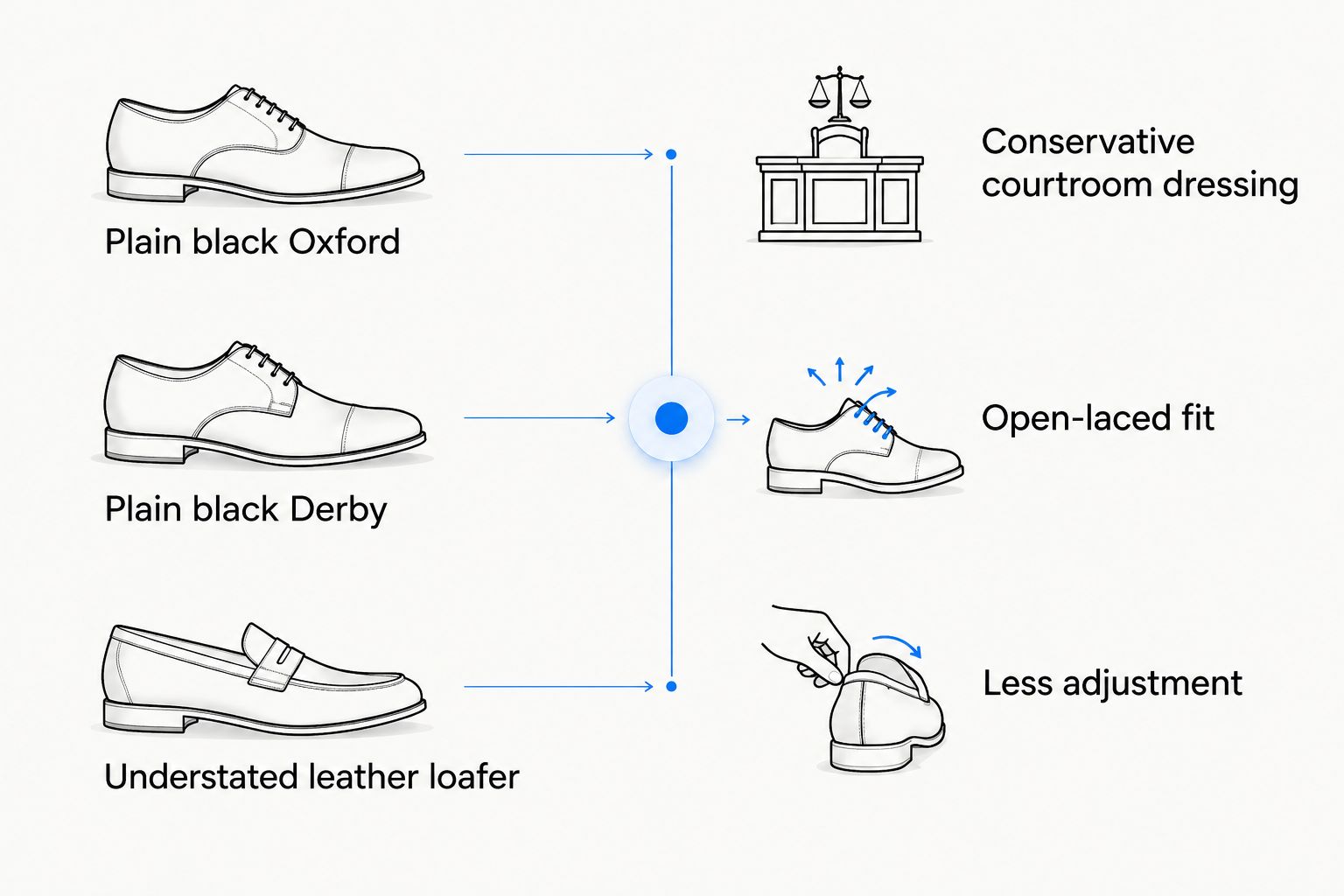
| Plain black Oxford | Conservative courtroom dressing | Closed lacing and minimal detail create a restrained appearance | A particular last can still press across the instep |
| Plain black Derby | Judges who prefer an open-laced fit | Open lacing allows adjustment across the top of the foot | Its more open design looks less formal than a comparable Oxford |
| Understated leather loafer | Chambers and settings permitting slip-ons | A clean slip-on design works without laces | No laces means less ability to adjust the hold |
| Restrained monk strap | Settings accepting visible buckles | Offers a tailored alternative to lace-ups | Hardware adds visual emphasis |
| Velvet or patent evening shoe | Events specifically calling for evening dress | Complements a deliberately formal evening outfit | Evening formality does not make it the strongest daily courtroom choice |
The distinction is between courtroom restraint and evening formality. A highly polished evening shoe can be more conspicuous than a plain business shoe, despite both being described as formal.
Coordinate trousers, socks, and visible details
Evaluate the entire lower half of your outfit while seated as well as standing. A robe does not remove the need to coordinate trousers, socks, and footwear; shoes become more noticeable when surrounding details compete.
For your 2026 courtroom wardrobe, begin with existing suits rather than building outfits around a decorative shoe. Black leather is a straightforward starting point for dark business tailoring. Keep buckles, contrasting panels, and strongly textured uppers out of the primary pair if visual restraint is your objective.
The same distinction between a professional-looking shoe and a workable professional shoe applies to kitten heels for legal professionals: a restrained silhouette still needs secure fit and suitability for the wearer’s duties. Appearance does not settle the practical questions.
Photograph your outfit at normal viewing distance. This exposes competing details more clearly than inspecting the shoes alone on a table.
- Check the trouser hem while standing and seated.
- Choose socks that maintain a continuous visual line.
- Keep visible hardware proportionate to the outfit.
- Assess the shoes with your robe and without it.
- Save decorative alternatives for suitable off-bench occasions.
Establish a care and replacement routine
Inspect your shoes before they become a distraction. Dust, damaged laces, uneven heel wear, and loose components deserve attention independently of the upper’s appearance.
Use care products appropriate to the stated material and finish. Smooth leather, suede, patent finishes, and exotic skins do not share one universal treatment. Follow manufacturer instructions, test an unfamiliar product discreetly, and avoid aggressive attempts to correct damage.
Your 2026 maintenance plan needs only 2 categories: routine care you can perform safely and repairs that need assessment. Cleaning and brushing belong in the first category when the method suits the material. Loose soles, damaged heels, or persistent structural problems belong with a qualified repairer.
Best for ownership planning: inspect condition rather than assuming a fixed lifespan. MensItalianShoes dress-shoe shoppers should assess repair potential for each model; a retailer category does not establish repairability.
- Remove surface dirt with a material-appropriate method.
- Let damp shoes dry away from direct heat.
- Use correctly fitting shoe trees where suitable.
- Inspect heels, soles, laces, and fastenings regularly.
- Seek repair advice before wear becomes structural damage.
Common mistakes judges make when choosing dress shoes
Equating evening formality with courtroom suitability
Velvet, patent finishes, and decorative details belong to different style contexts. A formalwear label does not establish that a shoe is the quietest choice beneath a judicial robe. Keep the everyday courtroom pair visually restrained.
Buying a narrow silhouette despite pressure
A sleek profile is not useful if your forefoot feels compressed. Check the last, width, and instep instead of increasing length automatically; extra length does not correct every fit problem. Persistent pain warrants professional assessment rather than another speculative purchase.
Assuming a robe makes footwear irrelevant
Shoes remain visible during movement and seated positions. Inspect them with your working outfit, including socks and trouser hems, rather than treating them as a separate accessory.
Treating luxury materials as occupational specifications
Leather quality and decorative craftsmanship do not prove traction, orthopedic suitability, or all-day comfort. Ask for relevant documentation when a specific functional requirement matters. Do not substitute a material description for evidence.
FAQ
What are the best Italian dress shoes for judges?
A plain black leather Oxford is the strongest starting point for restrained courtroom dressing. Choose a Derby instead when its shape and adjustment provide a better fit, and follow your court’s requirements.
Can judges wear loafers in court?
A judge should check the applicable court’s expectations before choosing loafers. If slip-ons are acceptable, favor understated styling and a secure fit without excessive heel movement.
Are Derby shoes less formal than Oxfords?
A Derby generally looks less formal than a comparable Oxford because it has open rather than closed lacing. Plain black leather and minimal decoration keep either style restrained.
Does shopping at an Italian-shoe retailer mean every pair is Italian-made?
No, a retailer’s name does not establish a shoe’s country of manufacture. Verify origin in the information for the individual pair and distinguish Italian-made from Italian leather or Italian-inspired design.
Should judges choose leather soles or rubber soles?
Choose the sole according to documented properties and your working environment, not material alone. Neither leather nor rubber by itself proves slip resistance or guarantees comfort.
Should new courtroom shoes feel tight until they break in?
New courtroom shoes should not cause pain, numbness, or compressed toes. Leather can soften with wear, but break-in is not a reliable correction for an unsuitable size or last.
How many pairs of courtroom shoes should I plan for?
Start with one appropriate, well-fitting pair before adding alternatives. A second working pair is a practical option for rotation or repair periods, not a judicial dress requirement.
One last thing
Inspect your shoes from a seated position before deciding they work. That is when trouser hems rise, socks become more visible, and a shoe’s proportions can look different from the standing mirror view. Make the final decision with the complete outfit—not the shoe box photograph.