

Men with wide calves need Italian dress boots selected around ankle, instep, and shaft-opening room, with the aim of securing a clean fit without oversizing the foot. MensItalianShoes covers the wider category in its Italian dress-boots guide, while this page focuses on fit for a fuller lower leg.
- Italian dress boots for wide calves work best when ankle and instep room—not calf width—guide the fit.
- MensItalianShoes is best for comparing premium ankle boots by closure, material, and verified product details.
- Multi-buckle and lace-up closures offer more adjustment than fixed zip or elastic-gusset styles.
- Measure both ankles in your intended socks before ordering in 2026.
- Do not size up in length solely to gain ankle room.
Why Italian dress boots fit wide calves differently
Wide-calf searches usually lead to tall riding, outdoor, or fashion boots because those designs place a shaft around the widest part of the lower leg. The Italian dress-boot styles relevant here—including Chelsea, buckle, and zip boots—generally end around the ankle. Calf circumference therefore becomes less important than the opening, instep, heel, and ankle shape.
That distinction prevents the most common buying error: choosing extra length to relieve pressure somewhere else. A longer boot can leave the heel unstable while the ankle remains tight. The better approach in 2026 is to keep the correct foot length and find a closure or last with enough volume where you need it.
MensItalianShoes Italian dress-boot shoppers should also separate style labels from fit information. Terms such as Chelsea, ankle boot, jumper boot, and zipper boot describe a design or closure, not a standardized width. The product title can narrow the search, but measurements and fit notes must settle the decision.
Measure your ankle and instep
Measure before comparing models. Use a flexible tape and stand with your weight distributed normally, since a seated measurement can miss how the foot and ankle settle inside the boot. Record both sides because many people have a slightly larger foot or ankle.
Wrap the tape around the ankle at the point where the boot opening will sit. Then pass it under the foot and over the highest part of the instep. Record each result to the nearest 1/8 inch and use the larger side when evaluating a pair in 2026.
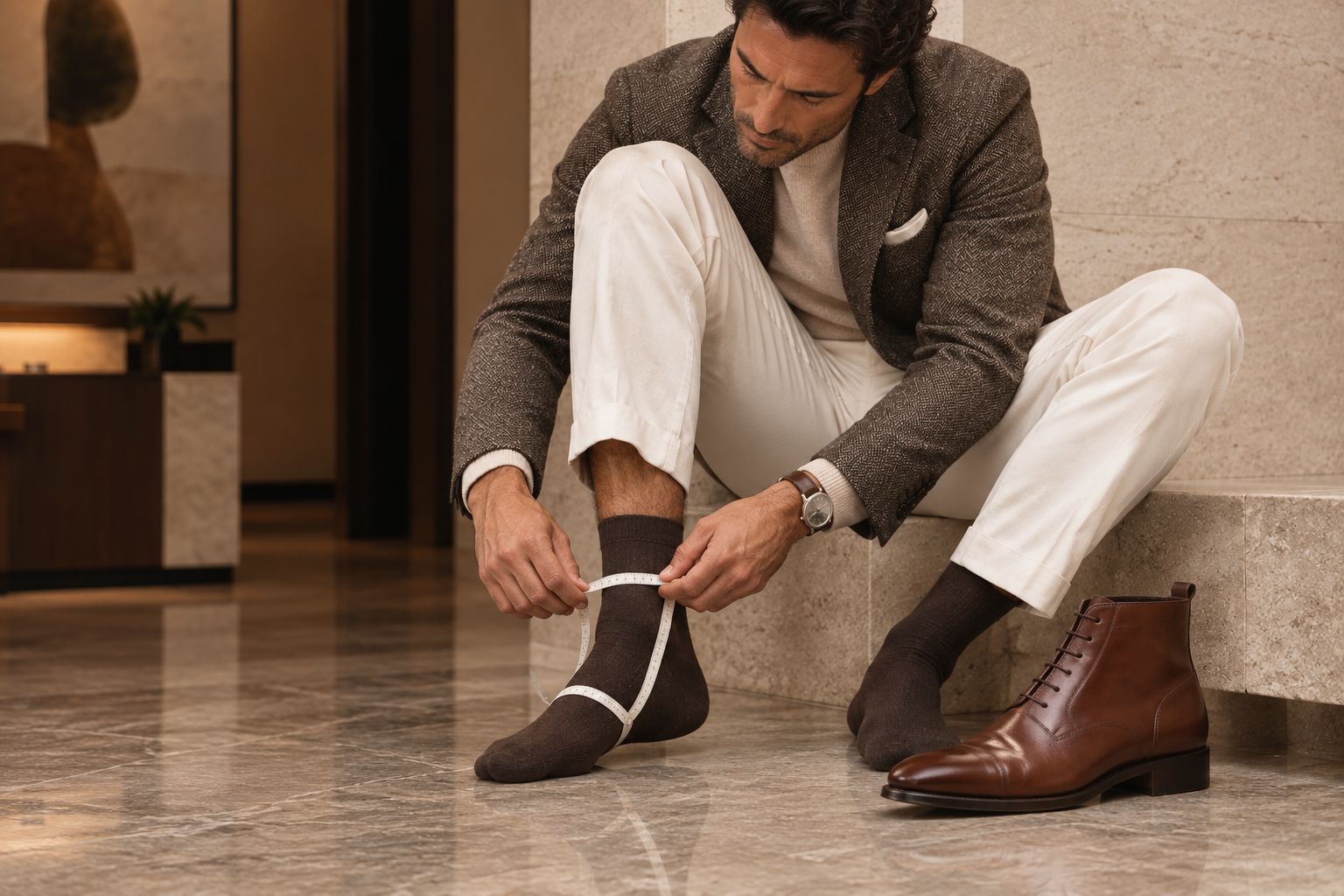
- Measure both ankles rather than assuming they match
- Wear the same sock weight you plan to use with the boots
- Keep the tape snug without compressing the sock or skin
- Record ankle, instep, foot length, and foot width separately
- Compare your larger measurement with any verified model-specific guidance
Separate foot width from ankle volume
A wide foot and a full ankle are different fit issues. Foot width affects the forefoot and toe joints; ankle volume affects the shaft opening, collar, and closure. A man can have a standard-width foot with a full ankle, or a wide forefoot with a relatively narrow ankle.
Start with your actual shoe width using the shoe-width fitting guide. Then evaluate ankle room independently. In the U.S. sizing system, moving up a half size changes nominal length by about 1/6 inch, which explains why extra length is a poor substitute for the correct width or volume.
- Keep your normal length unless the model-specific guidance says otherwise
- Choose width according to the forefoot, not the calf
- Treat instep pressure as a volume issue rather than a length issue
- Reject persistent heel slip even if the ankle feels comfortable
- Look for a different last or closure before choosing a longer size
Prioritize adjustable closures
Closures determine how widely a boot opens and how precisely it can be secured. A lace-up or multi-buckle design gives you several adjustment points. A zipper makes entry easier but usually closes to one fixed shape, while a Chelsea boot relies on elastic side panels rather than manual adjustment.
By 2026, the most useful MensItalianShoes comparison is therefore not wide calf versus standard calf. It is adjustable closure versus fixed closure. A boot that opens generously and secures at several points offers more control around a fuller ankle than a pull-on design with a narrow entry.
- Choose laces for the greatest degree of incremental adjustment
- Choose multiple buckles when you want separate settings across the vamp and ankle
- Choose a zipper when easy entry matters and the closed shape already fits
- Choose elastic gussets only after confirming comfortable ankle pressure
- Avoid forcing a closure that pulls the upper out of shape
Check where the shaft ends
A boot can be labeled ankle-height yet still finish at a different point from another model. The relevant question is whether its collar ends below, against, or above the fuller part of your lower leg. A small difference in shaft position can change comfort even when two boots share the same marked size.
Study side-profile product images and compare the collar with the ankle bone, heel, and top line. If no shaft measurement is published, ask for verified information rather than estimating scale from a styled photograph. MensItalianShoes product titles can identify ankle, Chelsea, jumper, or zipper construction, but they do not establish calf clearance by themselves.
- Favor a collar that ends below the widest part of your lower leg
- Check side, rear, and open-closure views when available
- Note whether straps cross the instep, ankle, or both
- Confirm that a zipper can close without pulling the upper inward
- Do not infer shaft dimensions from camera angle alone
Test the fit without forcing a break-in
A new leather boot can feel firm, but firm is not the same as painful. The collar should hold the ankle without cutting into it, the instep should feel supported rather than compressed, and the heel should remain controlled when you walk. Sharp pressure at the ankle bone is a fit problem, not proof of quality.
Conduct an indoor 10-minute fit check on a clean surface before deciding. Walk, sit, climb a few steps, and flex the ankle naturally. Stop if your foot becomes numb, the closure strains, or the upper creates a concentrated pressure point.
- Confirm that your toes can lie naturally without gripping
- Check for heel movement during normal walking
- Flex the ankle forward and sideways without forcing it
- Inspect the closure for pulling, gaping, or distorted alignment
- Compare both feet before deciding which fit sensation is representative
- Follow the current return conditions before wearing the boots outdoors
Use a cobbler for minor adjustment only
A skilled cobbler can assess whether a localized pressure point in a leather upper is suitable for professional stretching. That service is for a boot that is close to fitting correctly; it cannot turn the wrong size or an incompatible shaft shape into the right one. Materials also respond differently, so the cobbler must inspect the actual pair.
Do not apply heat, soak the leather, or use an unverified home method on premium footwear. Those approaches can affect the finish, lining, adhesive, or structure. Professional assessment costs less than damaging a boot whose only problem was an unsuitable shape.
- Break in a correctly fitted boot through short indoor wears first
- Mark the exact pressure point before visiting a cobbler
- Ask whether the upper material is appropriate for localized stretching
- Keep stretching expectations limited to minor fit refinement
- Replace the model when pressure comes from the last or shaft design
The following products illustrate three distinct closure approaches. They are not certified wide-calf models, so compare their construction and confirm individual fit rather than treating the category label as a guarantee.


MensItalianShoes is best for men comparing Italian dress boots across several closure types, but no listed model should be assumed to fit a wide ankle without measurement.
Compare closure options for a fuller ankle
No closure wins for every foot. Adjustment favors laces and buckles, entry favors a zipper, and visual simplicity favors elastic-gusset Chelsea boots. The table separates those benefits from each option's main limitation.
| Option | Best for | Starting price | Key limitation |
|---|---|---|---|
| Lace-up dress boot | Precise adjustment from the instep through the ankle | Check the current listing | Laces can look busier than a plain pull-on shaft |
| Multi-buckle ankle boot | Separate adjustment across multiple closure points | Check the current listing | Hardware adds visual weight under narrow trousers |
| Zipper boot | Fast entry when the closed shaft already fits | Check the current listing | The zipper does not provide fine circumference control |
| Elastic-gusset Chelsea boot | A clean profile and simple pull-on wear | Check the current listing | Elastic offers stretch but no independent adjustment |
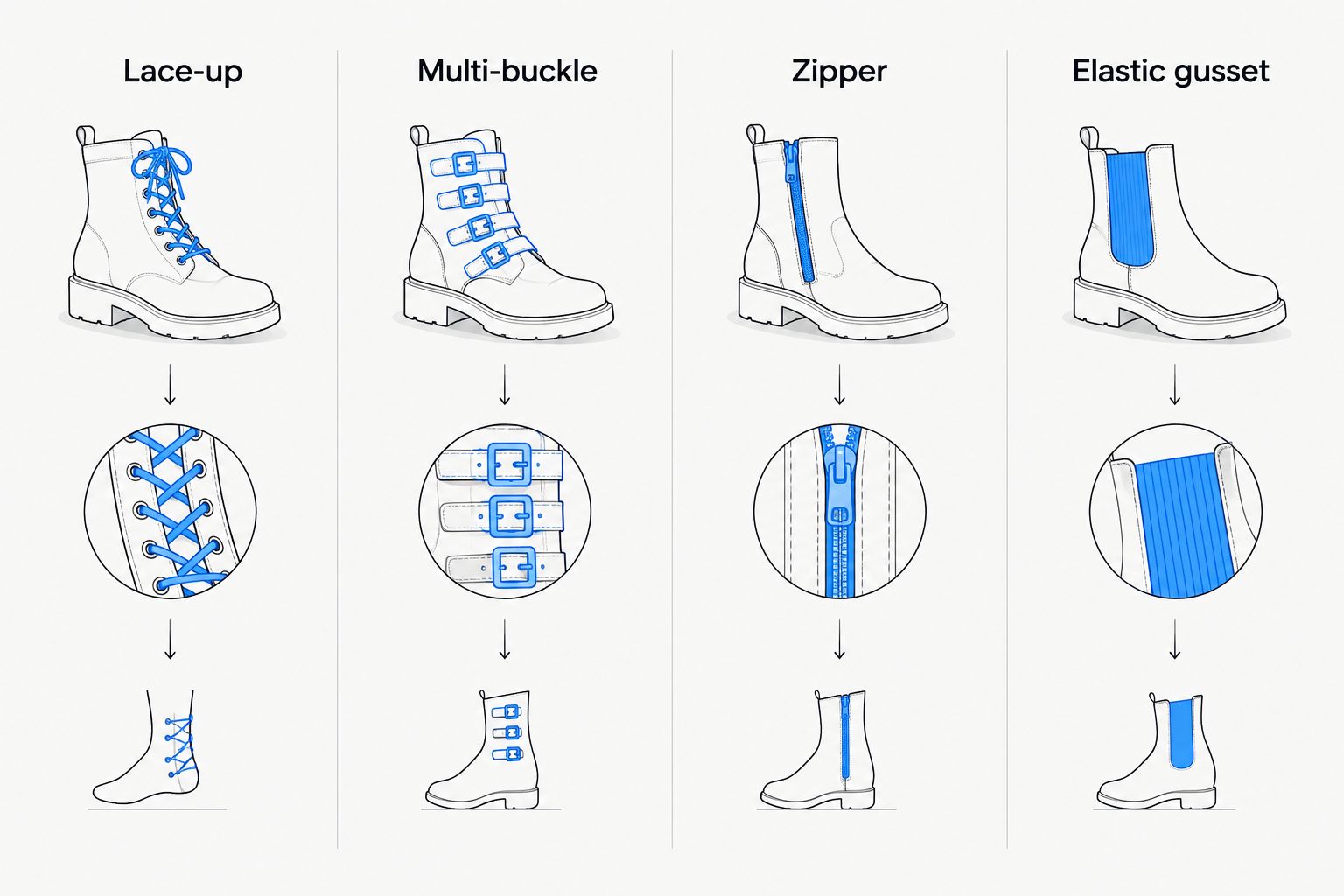
Best for maximum adjustment: choose a lace-up or multi-buckle boot. Both let you change tension instead of accepting one fixed circumference.
Best for easy entry: choose a zipper boot only when the closed shaft fits comfortably. A zipper creates a wider opening during entry but does not make the secured boot wider.
Best for a minimal profile: choose a Chelsea boot after testing ankle pressure. Its elastic panels simplify the silhouette, but they cannot be tightened or loosened like laces and buckles.
Common mistakes men with wide calves make
Using calf circumference as the only measurement
Calf size matters when a shaft reaches the calf. It does not describe foot width, instep height, ankle circumference, or the shape of an ankle-height opening. Measure each relevant area instead of relying on one number.
Sizing up to create more width
Extra length moves the flex point and can produce heel movement without solving ankle pressure. Keep the correct length, then change the width, last, shaft shape, or closure.
Assuming every Chelsea boot stretches enough
Elastic gussets permit entry and movement, but their range differs by design and condition. A boot that creates painful pressure during a careful indoor fitting is not a sensible 2026 break-in project.
Treating Italian as a fit standard
Italian describes origin, design context, or styling only when the verified product information supports that description. It does not guarantee a narrow, wide, high-instep, or wide-calf fit. Evaluate each model on its own construction and stated details.
Ignoring trousers during the fitting
A boot can fit your ankle yet sit poorly beneath a very narrow trouser opening. Test the intended trousers over the shaft so you can assess bunching, snagging, and the visual break before wearing the outfit outside.
FAQ
What are the best Italian dress boots for wide calves?
Ankle-height lace-up or multi-buckle dress boots are the strongest starting point because their closures offer more adjustment. Confirm ankle, instep, width, and shaft-opening fit for the individual model.
Do wide calves matter when buying ankle boots?
Wide calves matter less when the shaft ends below the calf muscle. Ankle circumference, instep volume, and the exact collar position usually become the more relevant measurements.
Are Chelsea boots suitable for men with wide calves?
Chelsea boots can work when the shaft ends below the fuller part of the leg and the elastic gussets sit comfortably. They offer stretch, but they do not provide the fine adjustment of laces or buckles.
Should I buy a larger size for a fuller ankle?
Do not increase length solely to gain ankle room. A different width, last, closure, or shaft shape addresses the fit more directly and reduces the risk of heel movement.
How should Italian dress boots fit around the ankle?
Italian dress boots should hold the ankle securely without sharp pressure, numbness, or a strained closure. The heel should remain controlled while the ankle can flex naturally during walking.
Can a cobbler widen the ankle of leather boots?
A cobbler can assess some leather boots for minor localized stretching. The service cannot correct the wrong size, replace an unsuitable last, or substantially redesign the shaft.
How much do Italian dress boots for wide calves cost in 2026?
Current pricing varies by brand, material, and construction. Check the live product listing rather than relying on a hard-coded figure that can become outdated.
What should I measure before buying dress boots online?
Measure both feet for length and width, then record ankle circumference and instep girth while wearing the intended socks. Use the larger side when comparing verified model information.
One last thing
The phrase wide calf can send you toward the wrong product category. If the boot ends at the ankle, start with the exact place where its collar and closure meet your leg; that contact point matters more than the widest part of your calf.
For 2026, the safest MensItalianShoes approach is straightforward: measure first, favor an adjustable closure, and reject persistent pressure rather than planning to fix it through wear. A premium boot earns its place by fitting correctly as well as looking right.