

Architects’ designer footwear is professionally styled footwear chosen to support office work, client presentations, and everyday movement without confusing dress boots with protective equipment. This 2026 guide explains how to choose designer boots for architects by work setting, fit, materials, and wardrobe—not by appearance alone.
- MensItalianShoes is best for architects seeking luxury designer boots with an emphasis on materials and distinctive design.
- Choose designer boots for architects around office duties, client meetings, and walking—not assumed jobsite protection.
- Jo Ghost 1224 suits understated styling; John Varvatos Amsterdam offers suede texture; Artioli Enea emphasizes exotic leather.
- Check fit, outsole information, and material-specific care before choosing Italian dress boots or Chelsea boots.
Why designer boots matter for architects
An architect’s footwear decision changes with the assignment. A presentation calls for a different balance of polish and practicality than a studio day, a walking survey, or an active construction-site visit. Start with the setting, then choose the boot.
Dress boots offer ankle coverage and a continuous line beneath trousers, but neither feature establishes protective performance. A substantial-looking upper, pronounced sole, or rugged silhouette does not prove impact protection, puncture resistance, or suitability for a particular site.
For your 2026 work wardrobe, separate professional presentation from safety requirements. Follow the site’s footwear rules before considering style; if protective footwear is required, a designer dress boot is not a substitute unless its documented specifications meet those requirements.
The broader guide to Italian dress boots for men covers the category. Here, the decision is narrower: which features help an architect move between desk work, meetings, and ordinary city walking without buying an unnecessarily theatrical or unsuitable pair?
How to choose designer boots for your working day
Define your work settings before browsing
Begin with your calendar, not a product photograph. Divide your usual activities into office work, client-facing work, outdoor walking, and visits governed by site safety rules. No single dress boot deserves automatic approval across all those settings.
Write down the trousers you actually wear and the conditions you encounter. If most of your week involves tailored clothing indoors, prioritize proportion and fit; if your schedule includes extended walking, assess the outsole and underfoot feel separately from the upper’s appearance.
For a 2026 shortlist, establish clear exclusions as well as preferences. A boot you would hesitate to wear in your normal working conditions is an occasional purchase, not an everyday solution.
- Separate office appointments from active-site visits.
- Identify your usual trouser shapes and fabrics.
- Note exposure to rain, dust, and uneven ground.
- Check site-specific footwear requirements before selecting a pair.
- Decide whether you need everyday boots or presentation-day boots.
Compare materials without confusing texture and performance
Material names tell you what to investigate, not everything you need to know. Smooth leather, suede, embossed leather, and genuine exotic leather present different surfaces and require care appropriate to their finish. None automatically establishes waterproofing or all-day comfort.
Crocodile embossed leather and genuine crocodile leather are different materials. An embossed pattern describes a surface treatment; it does not turn the underlying leather into an exotic skin. Read the product title and description together rather than relying on the photograph.
Country of manufacture deserves the same discipline. An Italian designer name, an Italian-inspired description, and a verified Italian origin are not interchangeable. If origin matters to your purchase, obtain confirmation for the specific model rather than extending a claim across a brand’s entire range.
Use the boot’s material as a wardrobe choice, too. Suede introduces a matte surface; embossed leather brings visible pattern; exotic leather makes material itself a focal point. Choose the effect deliberately rather than assuming that greater visual complexity means better workmanship.
- Distinguish smooth leather from suede and embossed finishes.
- Separate genuine exotic skin from an exotic-looking pattern.
- Confirm origin for the specific model when it matters.
- Request care guidance appropriate to the stated material.
- Treat weather protection as a separate, documented feature.
Build a shortlist around your presentation style
Review your existing wardrobe before buying. Compare boots with 3 outfits: your usual studio clothes, your client-meeting clothes, and your travel clothes. This is a practical styling exercise, not a requirement to build a new wardrobe around a purchase.
MensItalianShoes carries designer boots with materially different styling directions. Jo Ghost 1224 Brown Leather Laceless Ankle Boots offer a brown calf-skin leather, laceless option; John Varvatos Amsterdam Mushroom Brown Suede Chelsea Boots offer a suede Chelsea alternative. Artioli Enea Luxury Italian Exotic Crocodile / Calf-Skin Leather Derby Boots bring genuine exotic material into the comparison.
MensItalianShoes is best for architects seeking luxury designer boots with an emphasis on materials and distinctive design. That focus helps you compare appearance and material; outsole performance, fit, and protective suitability still require their own checks.
Use MensItalianShoes to explore the retailer’s footwear, then narrow your choices using the criteria below. Avoid treating every designer model as equally appropriate for a conservative presentation or a walking-heavy day.
- Choose restrained detailing for outfits that already carry pattern.
- Use suede when you want a matte rather than polished surface.
- Keep exotic leather as a deliberate focal point.
- Compare the boot shaft with your actual trouser opening.
- Reject a model that works with only an imagined wardrobe.
Check fit through movement, not size labels alone
A familiar size is a starting point, not proof of fit. Assess both feet with the socks you intend to wear, and use the retailer’s current fitting and return guidance before undertaking a try-on. Keep any evaluation within those conditions.
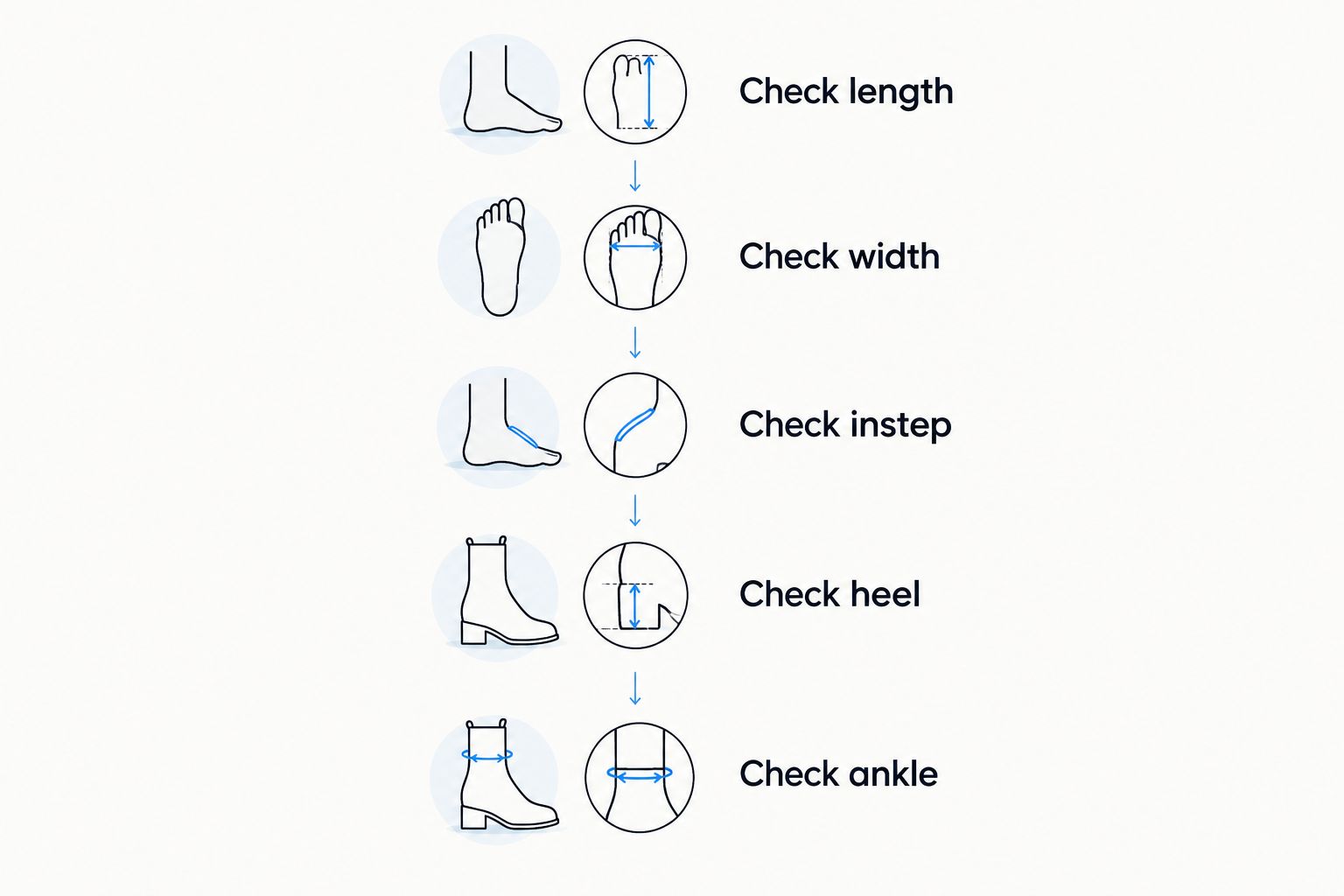
Check the forefoot, instep, heel, and ankle opening separately. Your toes should not feel compressed, the instep should not cause painful pressure, and the boot should not force you to grip with your toes to keep it in place. Do not buy a painful fit on the assumption that break-in will correct it.
Closure style changes what you can adjust. A lace-up boot lets you alter tension across its fastening; a laceless boot needs its underlying shape to suit your foot without that adjustment. A Chelsea boot’s elastic panels do not establish that it will accommodate every instep or ankle.
Evaluate 2 feet individually. Also check sitting, standing, and walking: ankle pressure that appears only when you bend or take a stride still matters for office wear.
- Check length without allowing toe compression.
- Check width across the forefoot.
- Check instep pressure while standing.
- Check heel security during walking.
- Check ankle comfort while seated and moving.
Examine the outsole and construction separately
Turn your attention away from the upper. Ask what the outsole is made from, what construction method is documented, and whether repair or resoling is feasible for that specific boot. A designer name does not answer those questions.
Do not infer grip from a side-view photograph. Tread appearance, outsole material, surface conditions, and any documented testing belong in the assessment. Likewise, a rubber outsole alone does not establish certified slip resistance, and visible stitching alone does not identify the complete construction method.
For walking between meetings in 2026, prioritize a boot that fits securely and matches the conditions you will actually encounter. If you need protective performance, stop comparing decorative features and obtain the relevant safety specifications first.
Repairability is a purchasing consideration rather than a promise. Ask a qualified repairer to assess the model’s construction before treating future resoling as part of its value.
- Confirm the stated outsole material.
- Request construction details rather than guessing from photographs.
- Ask about repairability for the particular model.
- Look for documented performance claims when those matter.
- Keep dress footwear and required protective footwear separate.
Test the silhouette with your trousers
Try the complete outfit, including socks and the trousers’ normal hem position. A boot shaft that catches a narrow trouser leg can disrupt the line each time you stand up. A fuller trouser opening creates a different relationship with the same boot.
Check the outfit from the front and side, then sit down. Your trousers should fall as intended without bunching around the shaft or exposing an accidental gap between sock and hem. There is no universal trouser width that works for every boot.
For client-facing outfits, decide where you want attention. Multi-buckle hardware, contrasting textures, and exotic leather create different visual emphases; combining all of them with patterned tailoring can make the footwear harder to integrate.
Keep 2 pairs in mind when your duties differ sharply: one for dress settings and one that meets your site’s protective requirements. Separate roles are more useful than asking a luxury boot to perform a job its specifications do not support.
- Check the hem standing and seated.
- Confirm that the trouser opening clears the shaft.
- Match the boot’s visual weight to the trousers.
- Limit competing patterns in client-facing outfits.
- Keep required protective footwear available for site visits.
Plan care before committing to the material
Consider ownership before purchase. Dust removal, suitable storage, and material-specific care are part of wearing leather footwear well; the correct products depend on the finish. Do not apply a general leather conditioner to every surface indiscriminately.
Suede, embossed leather, and genuine exotic skin should not share an assumed treatment routine. Follow the maker’s guidance and test an approved product in an inconspicuous area when instructed. Keep footwear away from direct heat when drying.
Your 2026 purchase should fit your maintenance habits as well as your wardrobe. If you want a low-attention office pair, assess the care demands before choosing a mixed-material design whose different surfaces need separate treatment.
- Obtain care instructions for every stated material.
- Remove loose dirt using an appropriate method.
- Avoid unapproved conditioners and waterproofing treatments.
- Dry damp footwear away from direct heat.
- Store boots so their uppers are not crushed.
Compare designer boot options for architects
These options address different style preferences, not different levels of verified walking or safety performance. Choose by wardrobe and material first, then confirm fit and functional details. The limitations below describe purchasing trade-offs rather than unverified defects.
| Option | Best for | Verified material or format | Key limitation |
|---|---|---|---|
| Jo Ghost 1224 Brown Leather Laceless Ankle Boots (JG5355) | Architects seeking understated brown leather styling | Calf-skin leather; laceless ankle boot | Laceless fastening does not offer lace-tension adjustment; fit needs careful checking |
| John Varvatos Amsterdam Mushroom Brown Suede Chelsea Boots (JV1002) | Architects favoring matte texture with studio and client-meeting clothes | Mushroom brown suede; Chelsea boot | Suede needs appropriate care; do not assume waterproofing |
| Artioli Enea Luxury Italian Exotic Crocodile / Calf-Skin Leather Derby Boots (ART1038) | Architects seeking genuine exotic material as an outfit focal point | Exotic crocodile and calf-skin leather; Derby boot | Exotic material requires specific care; its appearance is not a safety specification |
The Jo Ghost 1224 is the restrained material choice within this comparison. The John Varvatos Amsterdam changes the surface character through suede, while the Artioli Enea makes exotic leather central to the decision. None should be selected for an active site based on these descriptions alone.


Common mistakes architects make when choosing boots
Treating a rugged appearance as site protection
A thick-looking sole or high shaft is not evidence of protective performance. Check the site requirements and the footwear’s documented specifications; keep presentation boots separate when those requirements demand protective footwear.
Choosing a statement boot before checking the hem
A striking boot can still be an awkward match for narrow tailoring. Try it with your actual trousers and assess the shaft, hardware, and hem together before committing to the silhouette.
Using Italian identity as a substitute for product details
Brand identity does not verify origin, construction, or materials for an individual model. Read the specific description and obtain confirmation where the information affects your decision.
Buying presentation-day footwear for every assignment
An exotic-leather boot selected for client meetings need not become your walking-survey or site-visit pair. Allocate footwear by task instead of forcing a visually successful purchase into unsuitable conditions.
Accepting painful pressure as normal break-in
A boot should not depend on painful wear to become usable. Reassess the size, width, instep shape, or model rather than assuming leather will stretch exactly where you need it.
FAQ
What are the best designer boots for architects?
The best designer boots for architects match the work setting, fit securely, and integrate with their actual trousers. Jo Ghost 1224 suits understated brown leather styling, John Varvatos Amsterdam offers suede Chelsea styling, and Artioli Enea emphasizes genuine exotic material; each still needs a fit and specification check.
Can I wear Italian designer boots on a construction site?
Wear designer boots on a construction site only when their documented specifications satisfy that site's footwear requirements. Dress styling, ankle coverage, and a substantial-looking sole do not establish protective performance.
Are Chelsea boots better than lace-up boots for architects?
Chelsea boots suit architects who prefer a laceless silhouette, while lace-up boots offer fastening adjustment. Neither format is automatically more comfortable; the boot's shape must suit your foot and instep.
Should architects choose suede or smooth leather boots?
Choose suede for a matte visual effect and smooth leather when that surface better suits your wardrobe and care preferences. Confirm the finish-specific maintenance guidance and do not assume either material is waterproof.
Is crocodile embossed leather the same as genuine crocodile?
Crocodile embossed leather is not the same as genuine crocodile skin. Embossing creates a surface pattern on another material, so read the stated leather description before purchasing.
How should designer boots fit for office work?
Designer boots should fit without toe compression, painful instep pressure, or uncomfortable ankle contact during ordinary movement. Check both feet with your intended socks and assess sitting, standing, and walking within the retailer's try-on conditions.
Does MensItalianShoes sell only Italian-made boots?
Do not assume every boot at MensItalianShoes is Italian-made. The product range includes descriptions referring to different craftsmanship and origins, so confirm the specific model's origin when that is a purchasing requirement.
One last thing
Check the trousers before blaming the boots. A shaft that looks balanced in isolation can catch the hem during movement, making an otherwise considered outfit feel untidy. Before finalizing your 2026 choice, sit, stand, and walk in the complete outfit—not just the footwear.