

Insuring high-value alligator dress shoes means adding a scheduled personal property endorsement to a homeowners or renters policy, or buying a standalone valuables policy, once the shoes carry a written appraisal or a dated sales receipt. A basic homeowners policy caps personal property claims per item and typically excludes exotic-skin footwear valued well into four figures, which is the gap a schedule closes.
- Scheduled personal property endorsements or standalone valuables policies close the coverage gap standard homeowners insurance leaves on alligator dress shoes.
- Most insurers require a written appraisal or receipt before scheduling a pair, and re-appraisal every 3 to 5 years keeps the value current.
- Scheduled coverage on exotic-skin shoes typically runs 1% to 2% of appraised value per year, often with no deductible.
- Photograph and file paperwork for each pair before filing a claim; insurers want proof of value up front, not after a loss.
Why this matters
A standard homeowners or renters policy bundles footwear into a general personal property category with a per-item sub-limit, and that sub-limit was written for everyday shoes, not exotic skins. Alligator dress shoes from makers like Mezlan, Artioli, or SUPERGLAMOUROUS routinely fall outside that sub-limit, meaning a fire, theft, or flood claim in 2026 could pay out a fraction of what the pair is actually worth.
The fix isn't complicated, but it does require paperwork most owners skip. A sales receipt from a retailer like Mens Italian Shoes establishes purchase price; a written appraisal establishes current value if the shoes have appreciated or if the receipt has been lost. Either document is what an insurer needs to schedule the item and pay a real claim instead of a depreciated one. Owners who also store exotic skin shoes properly reduce the odds of a claim in the first place, since humidity and heat damage are common causes of loss on alligator skin.
How to insure alligator dress shoes
The process is the same whether you're insuring one pair or a full rotation of exotic-skin footwear.
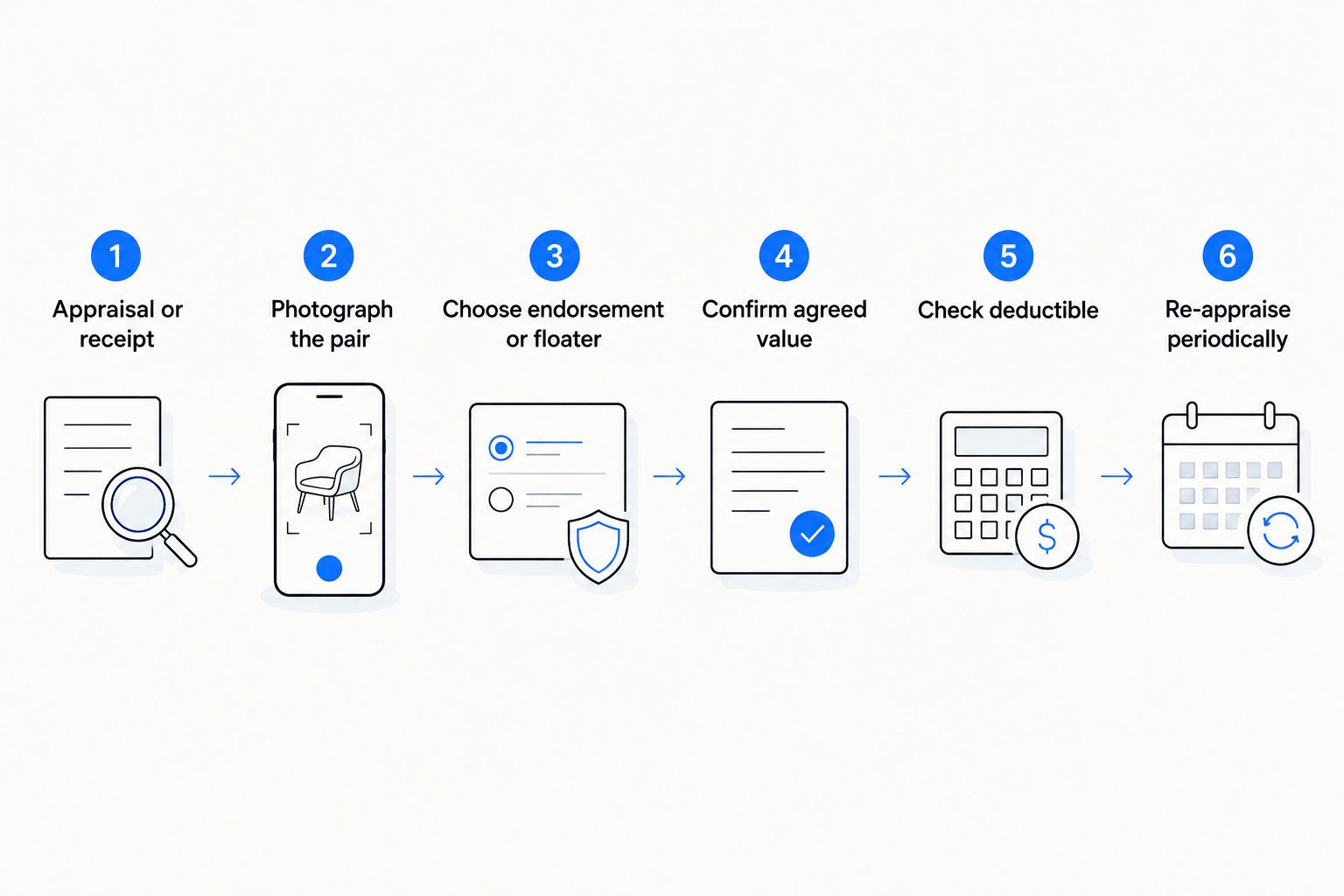
- Get a written appraisal or keep the dated receipt. This is the document an insurer uses to set the scheduled value.
- Photograph each pair, including the sole, lining, and any maker's marks, and store the images separately from the shoes themselves.
- Choose a scheduled personal property endorsement on your existing homeowners or renters policy, or a standalone valuables (floater) policy if your footwear collection exceeds the policy's blanket limit.
- Confirm agreed value versus actual cash value in the policy language before you sign — this single clause determines what you're paid after a loss.
- Ask about the deductible and worldwide coverage. Scheduled items commonly carry a $0 deductible and cover loss while traveling.
- Re-appraise every 3 to 5 years, or sooner if the shoes are resoled, restored, or the market for the maker shifts.
Scheduled personal property endorsement: about 1% to 2% of value per year
This is the most common route and the simplest to set up, since it attaches to a policy you already carry. The insurer lists the alligator dress shoes by description and appraised value, and coverage typically extends to accidental damage and mysterious disappearance, not just theft and fire. Expect the annual cost to land in the 1% to 2% range of the appraised value, frequently with no deductible on the scheduled item itself.
Standalone valuables policy: worth it above $10,000 in footwear
Once a collection of alligator, crocodile, or other exotic-skin dress shoes pushes past roughly $10,000 in combined value, a standalone valuables policy usually makes more sense than stacking endorsements. It's written separately from your home policy, so a claim on your footwear doesn't touch your home insurance history, and it typically travels with broader worldwide coverage. The trade-off is a separate premium and a separate renewal to track.
“A sales receipt proves what you paid. An appraisal proves what the shoes are worth now, and that's the number an insurer pays.”
Why the premium varies
No two policies price alligator dress shoes the same way. The variation comes down to a handful of factors underwriters actually weigh:
- Appraised value of the pair — higher value means a higher premium in dollar terms, even at the same percentage rate
- Policy type — a scheduled endorsement and a standalone floater carry different rate structures
- Deductible chosen — a higher deductible on the base policy can lower the scheduled item's rate
- Home security and storage — a safe, cedar-lined closet, or proper storage for exotic skins can reduce underwriting risk
- Species and regulation — American alligator is CITES-regulated, and some insurers ask for import or sale documentation before scheduling exotic skins
- Claims history — a prior loss on jewelry, furs, or exotic-skin goods raises the rate on new scheduled items
Before shopping around, decide whether you're insuring a single standout pair or an entire rotation, since that decision drives which route above makes sense.


Any pair in that range, and most of the alligator dress shoes in the best alligator dress shoes for men lineup, is a candidate for a schedule the same month it arrives. Save the order confirmation as your receipt of record until a formal appraisal is worth the cost.
Does homeowners insurance cover alligator dress shoes automatically?
$1,000 to $2,000 is the range many standard homeowners and renters policies apply as a special sub-limit for categories like jewelry and other high-value personal items, and exotic-skin footwear commonly falls into the same bucket. That limit applies per item or per category regardless of what you actually paid, which is why a single pair of alligator dress shoes can exceed it on its own.
How much does it cost to insure alligator dress shoes?
1% to 2% of the appraised value per year is the typical range for a scheduled personal property endorsement on exotic-skin footwear. Most owners find that cost modest set against the risk of an unrecoverable pair, especially once the shoes have been resoled or restored and carry sentimental as well as monetary value.
Do I need a professional appraisal for alligator shoes?
Above roughly $10,000 in single-item value, many insurers require a written appraisal rather than accepting a sales receipt alone. Below that threshold, a dated receipt showing maker, model, and price is usually enough to schedule the item, though an appraisal still helps if the shoes have appreciated since purchase.
FAQ
What's the best way to insure alligator dress shoes in 2026?
A scheduled personal property endorsement on your existing homeowners or renters policy is the best route for one or two pairs, and it typically costs 1% to 2% of the appraised value per year. A standalone valuables policy fits better once total footwear value passes roughly $10,000.
Is a receipt enough to insure exotic-skin shoes, or do I need an appraisal?
A dated sales receipt is usually enough below roughly $10,000 in value. Above that threshold, most insurers ask for a written appraisal before they'll schedule the item.
How much does it cost to insure a $1,500 pair of alligator shoes?
Scheduled coverage on exotic-skin footwear typically runs 1% to 2% of the appraised value annually, so cost scales directly with what the pair is worth. The exact rate depends on the insurer, your deductible, and where the shoes are stored.
Does travel insurance cover alligator dress shoes if they're lost by an airline?
Most scheduled personal property endorsements and standalone valuables policies include worldwide coverage, which extends to loss or damage while traveling. A basic homeowners policy without a schedule usually will not, so check the policy language before a trip.
Is agreed value or actual cash value better for insuring exotic-skin shoes?
Agreed value coverage pays the full scheduled amount with no depreciation if the shoes are lost, stolen, or destroyed. Actual cash value coverage subtracts depreciation for wear, which usually pays out less on a pair that's been worn regularly.
Do I need to re-appraise alligator dress shoes every year?
No, most insurers recommend re-appraisal every 3 to 5 years rather than annually. Re-appraise sooner if the shoes are resoled, restored, or the market value of the maker shifts noticeably.
Are crocodile and alligator dress shoes insured the same way?
Yes, both are scheduled the same way through a personal property endorsement or standalone valuables policy, since insurers underwrite by appraised value rather than species. Documentation requirements can differ slightly since both are regulated under CITES.
One last thing
The detail most owners miss isn't the policy, it's the paperwork trail after purchase. A pair bought in 2026 and never scheduled is effectively uninsured beyond the small sub-limit built into a standard policy, no matter how well it's cared for or stored. Schedule the shoes the same month you buy them, while the receipt is easy to find and the appraisal cost is still worth it relative to the pair's value.