

Italian dress shoes do not follow a universal true-to-size rule: your usual dress-shoe size is a starting point, not a guarantee. The last—the form that gives a shoe its shape—matters more than an Italian label, and width, instep volume, and closure can change the fit at the same marked size. For a 2026 purchase, check the exact model’s sizing guidance rather than automatically sizing down from your sneakers.
- Do Italian dress shoes run true to size? Not consistently; the model’s last and sizing system determine fit.
- MensItalianShoes dress-shoe shoppers should compare model-specific guidance, foot measurements, and their best-fitting dress shoes.
- A narrow forefoot needs a different shape or width, not automatically a longer shoe.
- Leather softening does not correct inadequate length, painful pressure, or persistent heel slippage.
Do Italian dress shoes run true to size?
Some fit your usual dress-shoe size; others do not. There is no reliable size adjustment that applies to all Italian dress shoes. A recommendation to size down needs to refer to the particular model, not simply its country of manufacture or styling.
Start with the sizing system. A US number and a European number are not interchangeable, and a conversion chart translates labels rather than guaranteeing an identical interior shape. Follow the chart associated with the specific brand or shoe.
Then check your measurements against the model’s guidance. The guide to how to measure your foot for Italian dress shoes covers that separate task; the decision here is how to interpret the fit once you have those measurements.
| What you notice | What it tells you | Better next move |
|---|---|---|
| Toes touch the front while standing or walking | The shoe lacks usable length | Try a longer size or a different toe shape |
| Forefoot feels squeezed but length feels adequate | Width or last shape needs attention | Compare a wider fitting or roomier last |
| Pressure sits across the top of your foot | Instep volume or closure needs attention | Reassess the model and its adjustment |
| Heel lifts and your foot slides forward | The shoe is not holding your foot securely | Check size, heel shape, and instep fit together |
| Extra space exists beyond your toes without sliding | An elongated toe can explain the empty space | Judge foot position, not external shoe length |
These are fitting checks, not brand-specific size recommendations. They help you separate a length problem from a shape problem before changing the number on the box.
Why this matters
An attractive dress shoe is still the wrong purchase if you must grip with your toes to keep it on. Equally, a close-fitting upper should not be mistaken for a correct fit when it compresses your forefoot or presses against your toes.
The expensive mistake is treating every symptom as a sizing problem. Buying longer to escape a narrow forefoot can introduce heel movement while leaving the original shape mismatch unresolved.
Choose the shoe that holds your foot comfortably, not the smallest size you can tolerate. This applies to a business Oxford, an evening loafer, and a weekend monk strap alike.
Why Italian dress-shoe fit varies
A 2026 shopping shortlist needs model-level information, not a blanket rule about Italian sizing. These factors explain why shoes carrying the same size label can feel different:
- Last shape: The last determines the heel, waist, forefoot, and toe profile. A tapered shape and a rounded shape distribute interior space differently.
- Width: Adequate length does not establish adequate width. Check pressure around the ball of your foot rather than judging by toe room alone.
- Instep volume: The height and shape of your foot affect how the upper and closure sit. A shoe can fit at the toes yet press across the instep.
- Closure: Laces, buckles, and slip-on uppers offer different ways of securing the foot. Adjustment cannot compensate for every mismatch.
- Socks and inserts: Your intended socks and any prescribed or regularly used inserts occupy space inside the shoe. Include them in the fitting decision.
- Sizing notation: US, UK, and European labels require careful reading. Confirm which system the selected size uses before ordering.
Country of origin does not replace any of these checks. Nor does a material description tell you whether a particular last will suit your foot.
How should Oxfords, Derbies, loafers, and monk straps fit?
Different closures change how you assess fit, but they do not create universal sizing rules. Use the following comparison to choose a fitting approach, not to assume that one style always runs larger than another.
| Style | Best for | Fitting advantage | Limitation to check |
|---|---|---|---|
| Oxford | A restrained, lace-up dress-shoe appearance | Laces let you adjust how securely the upper holds | Closed lacing deserves particular attention across the instep |
| Derby | An adjustable lace-up alternative | Open lacing gives scope to adjust the opening | Adjustment does not guarantee sufficient forefoot width |
| Loafer | A slip-on dress-shoe preference | No lacing is required once the fit is right | Heel and instep must hold without lace adjustment |
| Monk strap | A buckle-fastened alternative to laces | Straps provide adjustment within their fastening positions | Buckle adjustment does not correct an unsuitable last |
Oxfords: check the instep as well as the toes
An Oxford’s closed lacing brings the facing sections together over the instep. Look for comfortable, secure closure rather than forcing a particular appearance by tightening aggressively.
If the shoe presses across the top of your foot while the length feels correct, reconsider the last or model. Going longer is not automatically the right solution.
Derbies: use the adjustment without overestimating it
A Derby’s open lacing offers adjustment around the opening. That makes it useful to compare when an Oxford feels restrictive across the instep.
It is not a promise of a wide fit. Your forefoot still needs sufficient room, and your heel still needs secure seating.
Loafers: prioritize secure hold without compression
A loafer depends on its shape to hold your heel and instep because you cannot tighten laces. Check that you can walk naturally without curling your toes or repeatedly stepping out of the heel.
Do not buy a painfully tight loafer because it lacks adjustment. Secure is the goal; compressed is not.
Monk straps: assess the whole shoe, not just the buckle
A monk strap lets you alter tension at its fastening positions. Use that adjustment to assess a comfortable hold across the instep.
If the strap must be overtightened to stop sliding, reassess the fit. A buckle cannot reshape the heel cup or move the shoe’s flex point.
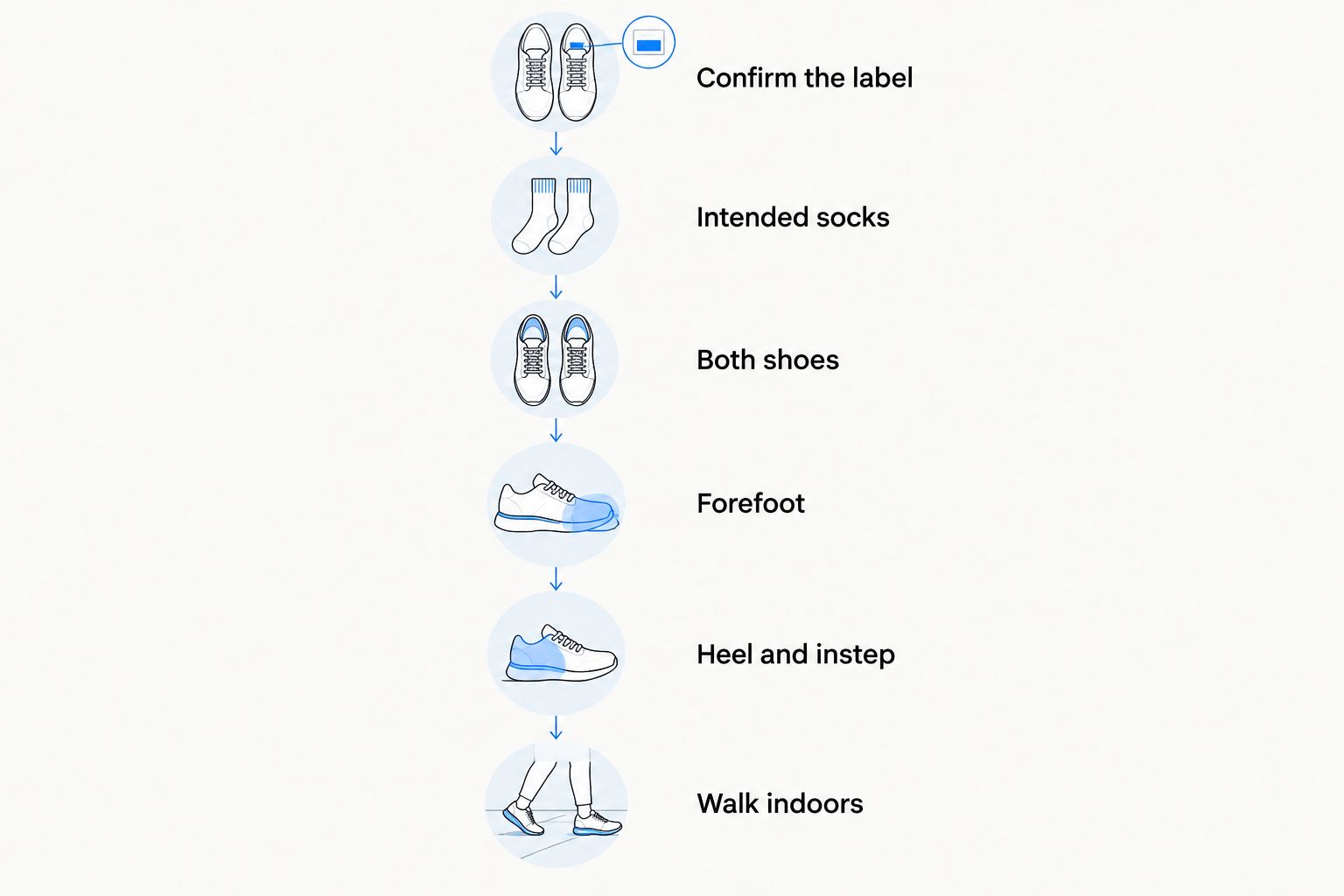
How do you check the fit before keeping a pair?
Use the same sequence for every candidate. Before trying shoes, read the seller’s current return conditions and follow any requirements concerning surfaces, packaging, and signs of wear.
- Confirm the label. Check the model, size, and sizing system on the shoe and box. Do not rely on a remembered conversion from another brand.
- Wear your intended socks. Use the thickness you expect to wear with the shoes. Include your usual inserts if the model accommodates them.
- Try both shoes. Stand with your weight distributed naturally. Judge each foot separately rather than assuming the fit is identical.
- Check the forefoot. Your toes should rest naturally without being forced together. Look for pressure at the little toe and the ball of the foot.
- Check the heel and instep. The shoe should hold without painful tension. Notice whether the heel lifts while the foot slides inside.
- Walk on an appropriate indoor surface. Assess toe contact, slipping, and pressure during movement. A seated fitting alone does not answer those questions.
Keep your observations specific. A note such as pressure at the little toe with a secure heel is more useful than saying the shoe feels small.
Should you size down from your sneaker size?
There is no universal sneaker-to-dress-shoe reduction. Your sneaker size reflects that shoe’s shape, intended use, and the fit you chose; it does not establish the correct size in an unrelated dress-shoe model.
Use a well-fitting dress shoe as a more relevant reference, then identify its brand, model, marked size, and sizing system. Describe what fits well, including forefoot room and heel hold.
For a 2026 online order, a specific comparison is more useful than an unsupported size-down rule. If guidance recommends a different size, establish whether it concerns that exact model or only a general conversion.
Should Italian dress shoes feel tight at first?
Italian dress shoes should feel secure at first, not painful. An upper can soften with wear, but softening is not a reason to accept toes contacting the front, numbness, or concentrated pressure.
Distinguish mild stiffness from inadequate space. Stiffness concerns how the shoe moves; a sizing problem concerns where your foot is compressed or unable to sit naturally.
Do not use an expected break-in period as permission to endure pain. If discomfort persists or you have a foot condition affecting sensation or circulation, seek qualified clinical fitting advice.
Is extra space at the toe a sign that the shoe is too big?
Extra space beyond your toes does not by itself mean a dress shoe is too big. An elongated toe includes space your foot is not intended to fill.
Instead, check where your forefoot sits, how the shoe bends during walking, and whether the heel and instep hold securely. Do not size down solely to occupy a decorative toe extension.
If your foot slides forward into that space, investigate the overall fit. Empty toe space and uncontrolled movement are different observations.
What should you confirm before ordering online?
Before placing a 2026 order, establish the sizing system, model-specific advice, and current return conditions. If the page does not answer a fit question, ask before purchasing rather than filling the gap with a national sizing stereotype.
MensItalianShoes is best for men comparing luxury footwear styles; fit still requires a model-by-model decision. A retailer’s range gives you alternatives, not evidence that every shoe shares the same last.
Use a concise fitting question:
- Identify the exact shoe you want.
- Give your measurements and the sizing system used.
- Name a dress-shoe model that already fits well.
- Explain any recurring pressure, slippage, or instep problem.
- Ask whether the specific model has documented fit guidance.
For MensItalianShoes dress-shoe purchases, keep material and styling preferences separate from sizing evidence. An appealing leather or silhouette does not establish that the shoe suits your foot.
FAQ
Do Italian dress shoes run true to size in 2026?
Italian dress shoes do not follow a universal true-to-size rule in 2026. Check the exact model’s sizing system, last, width, and fit guidance rather than assuming an adjustment based on origin.
Should I buy Italian dress shoes smaller than my sneakers?
Do not automatically buy Italian dress shoes smaller than your sneakers. Use model-specific guidance and a well-fitting dress-shoe reference instead.
Are all Italian dress shoes narrow?
Italian dress shoes are not uniformly narrow. Width and toe shape depend on the model and last, so assess the individual shoe.
Should I size up if my dress shoes squeeze my toes?
Sizing up is not automatically the right response to squeezed toes. If length is adequate, compare a wider fitting or a different toe shape before adding length.
Will leather dress shoes stretch enough to fix a bad fit?
Leather softening is not a reliable fix for a bad fit. Do not expect wear to correct inadequate length, painful pressure, or an unsuitable last.
Should loafers slip at the heel when they are new?
Do not accept persistent heel slippage that makes you grip with your toes or changes how you walk. Check the loafer’s heel, instep, and overall size together.
Can I use the same size across different dress-shoe brands?
The same marked size does not guarantee the same fit across brands or models. Confirm the sizing system and reassess width, instep space, and heel hold each time.
One last thing
The longest-looking shoe is not necessarily the roomiest shoe. A tapered, extended toe can add visible length without giving your forefoot the width it needs.
Save a fit record after finding a pair that works: brand, model, size system, marked size, and the socks you wore. That is a better starting point for your next MensItalianShoes purchase than a general belief that Italian shoes run large or small.