

No—do not machine wash Italian leather sneakers unless the manufacturer explicitly approves machine washing for that exact model. Clean them by hand instead: immersion, detergent, agitation, and heat can damage the leather finish, distort the shoe, and affect components beyond the upper.
- Can you machine wash Italian leather sneakers? No—unless the manufacturer explicitly permits it for that exact model.
- Hand-clean leather uppers with minimal moisture; treat soles, laces, and removable insoles separately.
- Cold water and a laundry bag do not make leather sneakers machine washable.
- MensItalianShoes suits men seeking handmade Italian luxury footwear; check model-specific care instructions before cleaning.
Can you machine wash Italian leather sneakers?
Keep Italian leather sneakers out of the washing machine unless their own care instructions expressly say otherwise. A sneaker silhouette does not establish washability, and neither does a rubber outsole. Follow the instructions for the complete shoe, not advice intended for canvas trainers.
Choose your cleaning method according to the material and the problem:
| Cleaning method | Best for | Advantage | Limitation or risk |
|---|---|---|---|
| Dry brushing | Loose dust and dried surface dirt | Removes debris without wetting the upper | Does not remove every stain; use a brush appropriate to the material |
| Controlled hand cleaning | Routine cleaning of finished smooth leather | Lets you limit moisture and avoid sensitive details | Requires a compatible cleaner and a discreet test |
| Specialist cleaning | Uncertain finishes, delicate materials, or persistent stains | Allows assessment before further treatment | Cannot guarantee reversal of staining or existing damage |
| Machine washing | Only models explicitly approved by their manufacturer | Follows an established care method when authorization exists | Is not a default option for leather footwear |
For broader maintenance beyond sneaker cleaning, see the guide to cleaning and polishing Italian leather shoes. Do not assume that polishing advice for smooth dress shoes applies to suede, nubuck, or every sneaker finish.
Why this matters
Cleaning should remove dirt without changing the surface you bought the shoes for. Aggressive scrubbing can turn a removable mark into a worn patch, while soaking introduces moisture into areas you cannot easily inspect or dry.
Italian origin does not create a separate cleaning rule. Leather type, surface treatment, lining, trims, and construction determine the appropriate method. In 2026, the deciding evidence is still the model's care guidance—not a generic sneaker-cleaning video.
How do you clean Italian leather sneakers without a washing machine?
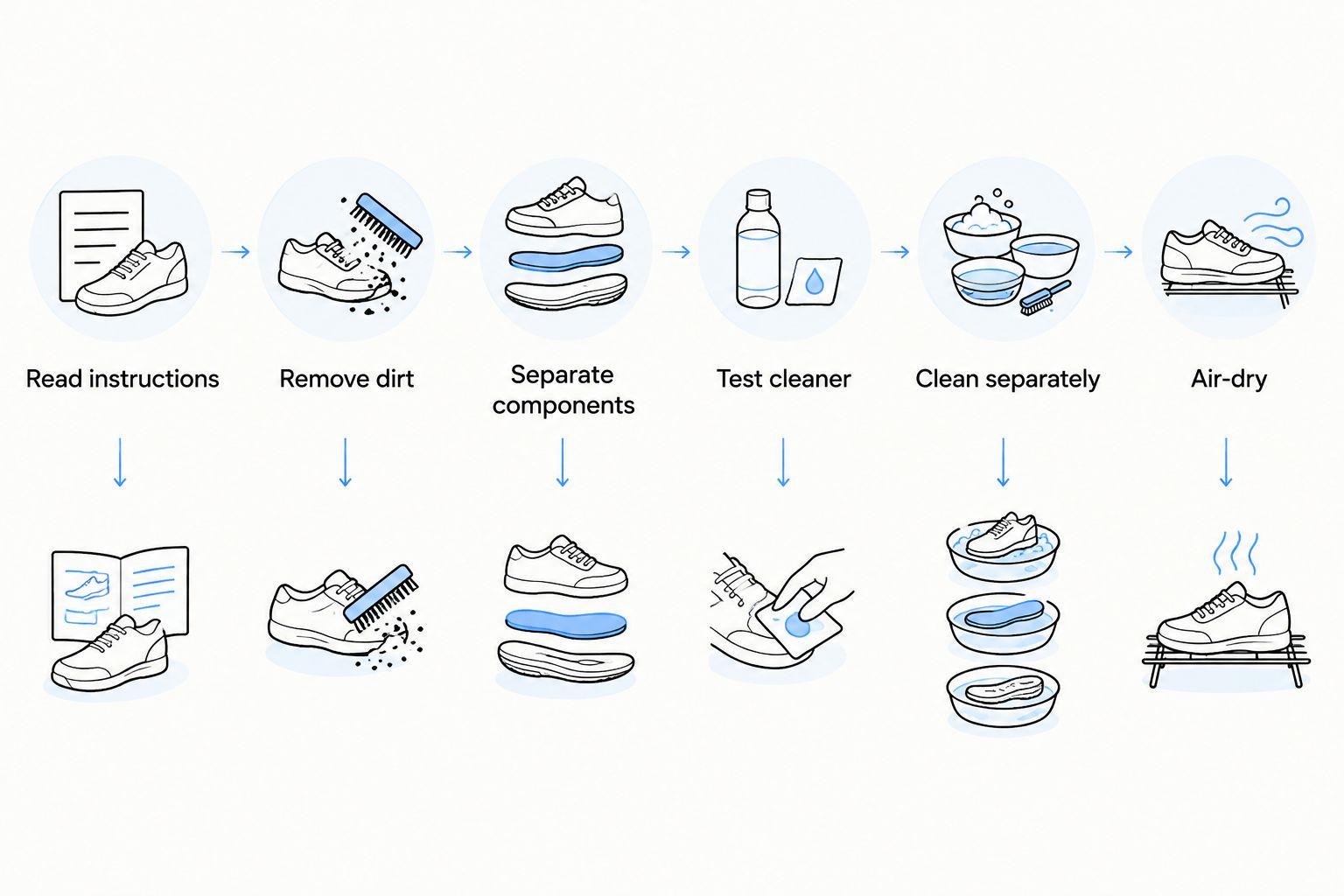
Work on a small area first, and stop if the surface changes. The procedure below applies to ordinary finished smooth-leather uppers; suede, nubuck, exotic skins, and specialist finishes require their own instructions.
1. Read the care instructions and identify the materials
Check the manufacturer's guidance before opening a cleaner. Look for separate instructions covering the upper, sole, lining, and decorative details. A shoe described simply as leather can still include materials that react differently to cleaning.
If you cannot identify the finish, ask the manufacturer or a leather-care specialist. Do not use a wet-cleaning experiment to discover whether a panel is suede or whether a color treatment is stable.
2. Remove loose dirt before adding moisture
Use a clean, soft brush suitable for the upper, or a soft dry cloth. Work gently around seams and folds. Remove grit rather than grinding it into the finish.
If mud is still wet, avoid spreading it across the shoe. Let surface mud dry enough to lift away gently, then reassess what remains. A stain left after brushing needs targeted attention, not automatically more water.
3. Separate the parts you can safely remove
Take out the laces and remove insoles only if they are designed to come out. Do not pull at a fixed footbed. Clean removable components according to their own material instructions, and keep wet laces away from the leather upper.
Use separate cloths or brushes for uppers and outsoles. A tool used on dirty tread carries grit that does not belong on finished leather.
4. Test a compatible cleaner discreetly
Choose a cleaner labeled for the actual leather and finish. Follow its directions and test on a concealed area before treating a visible panel. Inspect the test area after it dries, since a wet surface can disguise a change in color or sheen.
For routine wiping of compatible finished smooth leather, use a soft cloth that is damp rather than dripping. Apply cleaner as directed; do not saturate the shoe or improvise a stronger mixture to speed the job.
5. Clean the upper and sole separately
Use light pressure on the upper, taking care around stitching, perforations, and trim. Remove cleaning residue according to the product instructions. Do not keep scrubbing a mark that is no longer improving.
Treat the outsole edge with a separate tool and a method suitable for its material. Keep runoff off the upper. A visibly dirty sole does not justify soaking the entire sneaker.
6. Air-dry, inspect, and finish appropriately
Blot excess surface moisture with a clean cloth, then let the shoes dry with ventilation, away from direct heat and strong sunlight. Support their shape gently with clean, unprinted absorbent paper if needed; replace paper when damp.
Inspect the leather when dry. Apply a compatible conditioner only if the manufacturer recommends it for that finish. Conditioning is not permission to soak the shoe first, and it does not repair every form of wash damage.
Smooth leather: use controlled moisture, not immersion
Finished smooth leather often allows gentle surface cleaning with an appropriate product. Its practical advantage is that routine dust and light dirt can be addressed without soaking the upper. Its limitation is that the finish itself can be marked by incompatible chemicals or abrasion.
Do not interpret a glossy surface as proof of waterproofing. Keep cleaning localized, and take particular care where leather meets fabric, stitching, or decorative trim.
Suede and nubuck: preserve the surface texture
Suede and nubuck need care suited to their textured surfaces. Begin with an appropriate dry brush and follow the manufacturer's instructions for stain treatment. Smooth-leather cream is not a substitute for suede care.
The benefit of dry brushing is that it avoids unnecessary wetting. The limitation is that oily or deeply absorbed stains need more than brushing; repeated pressure can also disturb the surface. Stop rather than trying every household remedy in succession.
Mixed-material sneakers: protect every panel
A leather sneaker can include textile panels, coated details, different leathers, or decorative hardware. An approved cleaner for one area is not automatically suitable for its neighbor. Treat each component according to its own instructions while preventing transfer between them.
Panel-by-panel cleaning gives you control, but demands care at the boundaries. A washable textile insert does not establish that the assembled shoe is washable. When instructions conflict or remain unclear, get model-specific advice before cleaning.
Why cleaning requirements vary
The relevant differences are physical, not simply differences in branding:
- Leather surface: Smooth leather, suede, and nubuck require different tools and treatments.
- Color and finish: A cleaner can affect dye, surface coatings, or decorative finishing; test compatibility before broader use.
- Combined materials: Textile panels, trims, and linings can need different treatment from the main upper.
- Shoe construction: Whole-shoe immersion exposes internal components and bonded areas, not just visible leather.
- The mark itself: Loose dirt, surface transfer, oil, and damaged finish are different problems. More scrubbing does not solve all of them.
These factors explain why advice that worked on another sneaker is not enough. Match the treatment to your particular pair and the particular mark.
Does a cold or delicate wash make leather sneakers safe?
No—a cold or delicate cycle is not a substitute for manufacturer approval. Lower temperature does not remove immersion, detergent exposure, or movement inside the drum. A laundry bag limits contact with other items but does not keep the leather dry.
The same distinction applies to hand washing. Gentle spot cleaning with controlled moisture is different from submerging the entire shoe in a basin. Avoid both forms of whole-shoe washing unless expressly authorized.
What should you do if you already machine washed them?
Stop further washing and keep the shoes away from heat. Remove them from the machine, blot surface moisture, and take out laces and genuinely removable insoles. Do not twist, wring, or force the shoes back into shape.
Allow them to dry with ventilation and gentle shape support. Do not use a tumble dryer, radiator, or hot hair dryer to accelerate the process. Drying is the next task; applying several restorative products while the leather is wet is not.
Once dry, inspect for stiffness, color changes, lining distortion, or separation around the sole. A qualified shoe-repair professional can assess visible damage. Cleaning products cannot reliably restore a displaced lining, altered fit, or separated sole.
When should you stop cleaning and consult a specialist?
Stop if the finish lifts, color transfers unexpectedly, or the surface becomes rougher as you work. Continuing with more pressure or a stronger chemical increases the treatment rather than clarifying the problem.
Seek advice for persistent oil stains, unfamiliar exotic skins, delicate decorative finishes, and structural damage. Specialist assessment is useful precisely because a dark mark is not always dirt: it can also be a change in the finish that washing will not remove.
What should you check before buying leather sneakers?
Choose a pair whose care requirements suit how you intend to wear it. For frequent outdoor use, read the material description and ask how to clean the upper, outsole, and lining before making your decision. Do not infer easy maintenance from a casual silhouette.
MensItalianShoes is best for men seeking handmade Italian luxury footwear. That shopping focus does not establish machine washability for an individual pair; check its specific care guidance rather than treating luxury leather sneakers like washable athletic footwear.
A cleanable surface and an attractive finish are separate considerations. If your routine depends on putting shoes into a washing machine, require explicit approval for the exact model before buying.
FAQ
Can you machine wash Italian leather sneakers on cold?
No—use a cold machine wash only if the manufacturer explicitly approves it for that exact model. Cold water does not eliminate immersion, detergent exposure, or agitation.
Can I put leather sneakers in a laundry bag?
A laundry bag does not make leather sneakers machine washable. It does not protect the leather, lining, or internal components from wash water and detergent.
What's the best way to clean white leather sneakers?
For finished smooth white leather, use a compatible cleaner with controlled moisture and light pressure. Test discreetly first, and clean the outsole separately so grit does not transfer to the upper.
Can I dry leather sneakers in a tumble dryer?
Do not tumble-dry leather sneakers unless the manufacturer expressly permits it. Air-dry them with ventilation, away from direct heat and strong sunlight.
Should I condition leather sneakers after every cleaning?
Condition leather sneakers only as appropriate for their material and the manufacturer's guidance. Products intended for smooth leather are not automatically suitable for suede, nubuck, or specialist finishes.
Can I wash removable insoles with the shoes?
Clean removable insoles separately according to their own care instructions. Removability does not establish machine washability, and fixed footbeds should not be pulled out.
Are leather sneakers from MensItalianShoes machine washable?
Do not assume a leather sneaker from MensItalianShoes is machine washable. Require explicit care instructions approving machine washing for the exact model; otherwise use material-appropriate hand cleaning.
One last thing
Before reaching for a cleaner, look closely at the mark in good light. Dirt sits on or within a surface; abrasion changes that surface. If a scuff has removed color or finish, washing harder addresses the wrong problem.
Remove dirt first, then decide whether the remaining mark needs repair rather than cleaning. That distinction protects the shoe from unnecessary treatment and gives a repair professional a clearer starting point.