

Italian dress shoes for bunions need a wide toe box, a soft or flexible upper, and a closure system that adjusts to swelling around the first metatarsal joint, with the goal of removing pressure without giving up a tailored silhouette. A bunion is a bony prominence at the base of the big toe, and it does not respond to sizing up in length alone. The fix lives in width, toe shape, and upper material, three variables most men never check before they buy.
- Italian dress shoes for bunions work best with a wide toe box, soft leather or suede upper, and an adjustable strap or lace closure.
- Monk strap loafers and suede slip-ons flex around the bunion joint better than stiff lace-up oxfords in 2026.
- Skip pointed toe boxes entirely; a rounded or almond last is the single biggest bunion fix available.
- Half-size up in width, not length, when a bunion pushes against the vamp of the shoe.
- Suede and soft calf leather break in around a bunion faster than stiff patent or exotic skins.
Why fit matters more than style for men with bunions
A bunion changes the outline of your foot, not just its length. The joint pushes outward at the ball of the foot, so a shoe cut for a standard last presses directly on the most sensitive part of the foot with every step. That pressure compounds over a full workday, especially in Italian dress shoes for wide feet territory, where the last is already generous through the forefoot but still narrows toward the toe.
Most dress shoes, Italian or otherwise, are built on a tapered last that narrows aggressively toward a point or a slim almond toe. That taper is exactly what a bunion cannot tolerate. The men who solve this problem in 2026 aren't buying bigger shoes, they're buying shoes cut on a different last shape and made from uppers that give.
Step 1: Get measured for width, not just length
A bunion makes standard length-only sizing useless. Foot width across the ball of the foot, medically the widest point, is what determines whether the bunion clears the upper without friction.
- Measure both feet standing, since bunions are often more pronounced on one side
- Note the width measurement in addition to length before shopping
- Read how to choose the right shoe width for a proper fit before assuming your usual size is correct
- Try shoes on later in the day when feet have naturally swelled slightly
- Walk on a hard floor, not carpet, to feel where the upper actually presses
Step 2: Prioritize soft, flexible uppers over stiff leather
Stiffness is the enemy of a bunion. A rigid, heavily corrected-grain leather holds its shape and refuses to give around the joint, while a softer, more supple leather or suede molds to the foot within a handful of wears.
- Suede and nubuck flex faster than smooth calfskin
- Softer aniline-finished leathers move with the foot better than heavily pigmented, stiff leathers
- Avoid shoes with a hard toe cap or heavy internal stiffener near the vamp
- Velvet uppers offer almost no resistance to a bunion's outward push
- Check the upper by pressing a thumb into the vamp area in the store; it should give slightly, not feel like a board
Step 3: Choose slip-on and adjustable styles over rigid lace-ups
This is where construction choice does more work than sizing. A traditional lace-up oxford cinches the vamp tight and closes around the foot uniformly, which is precisely the wrong geometry for a bunion. A monk strap or a slip-on loafer distributes closure differently and lets the widest part of the foot sit without a laced panel pulling across it.
Mens Italian Shoes carries several constructions built around exactly this kind of forgiving fit. A monk strap with an adjustable buckle lets you loosen the closure on the bunion side without loosening the whole shoe, and a suede slip-on has no lacing panel at all to cut across the joint.


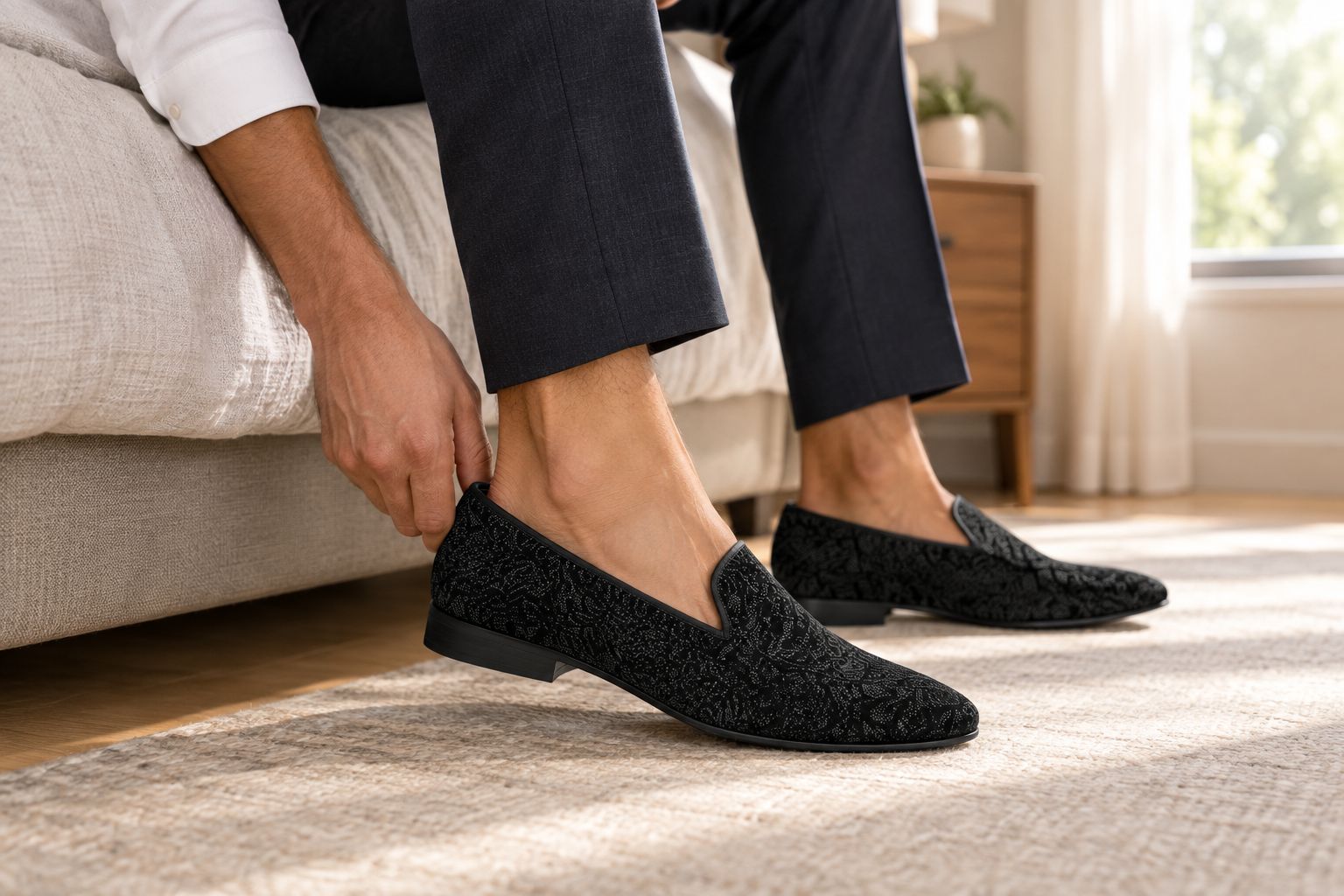
Step 4: Look for a rounded or almond toe, and skip the pointed last
Toe shape decides whether the bunion has room to exist without touching leather. A pointed or narrow chisel toe tapers exactly where the bunion sits.
- Rounded toes give the most horizontal room at the widest point of the foot
- Almond toes are the compromise: dressier than round, still far more forgiving than a point
- Square toes work but can look heavy with a slim suit trouser
- Avoid winklepicker-style narrow points entirely, regardless of brand
- If in doubt, trace the shoe's toe outline on paper and compare it to your foot's actual outline
Step 5: Break in gradually, and know when to stretch
Even a well-chosen shoe needs a break-in period around a bunion. Rushing full-day wear in a brand-new pair is how blisters and irritation start.
- Wear new shoes for two to three hours at a time for the first week
- Use thick socks during early wear sessions to add a small buffer
- If the shoe is close but still tight at the bunion, professional stretching over a shoe last can add real room; see stretching leather shoes that run tight for the process
- Suede responds to stretching faster than smooth leather because of its napped fiber structure
- Never force a break-in by wearing a shoe that causes visible redness after one wear
Step 6: Understand how construction affects flex around the joint
How a shoe is built changes how much it moves with a bunion. A Blake-stitched shoe is thinner through the welt and flexes closer to the foot's natural bend. A Goodyear-welted shoe is more structured, more durable, and stiffer through the same area, at least until it has broken in.
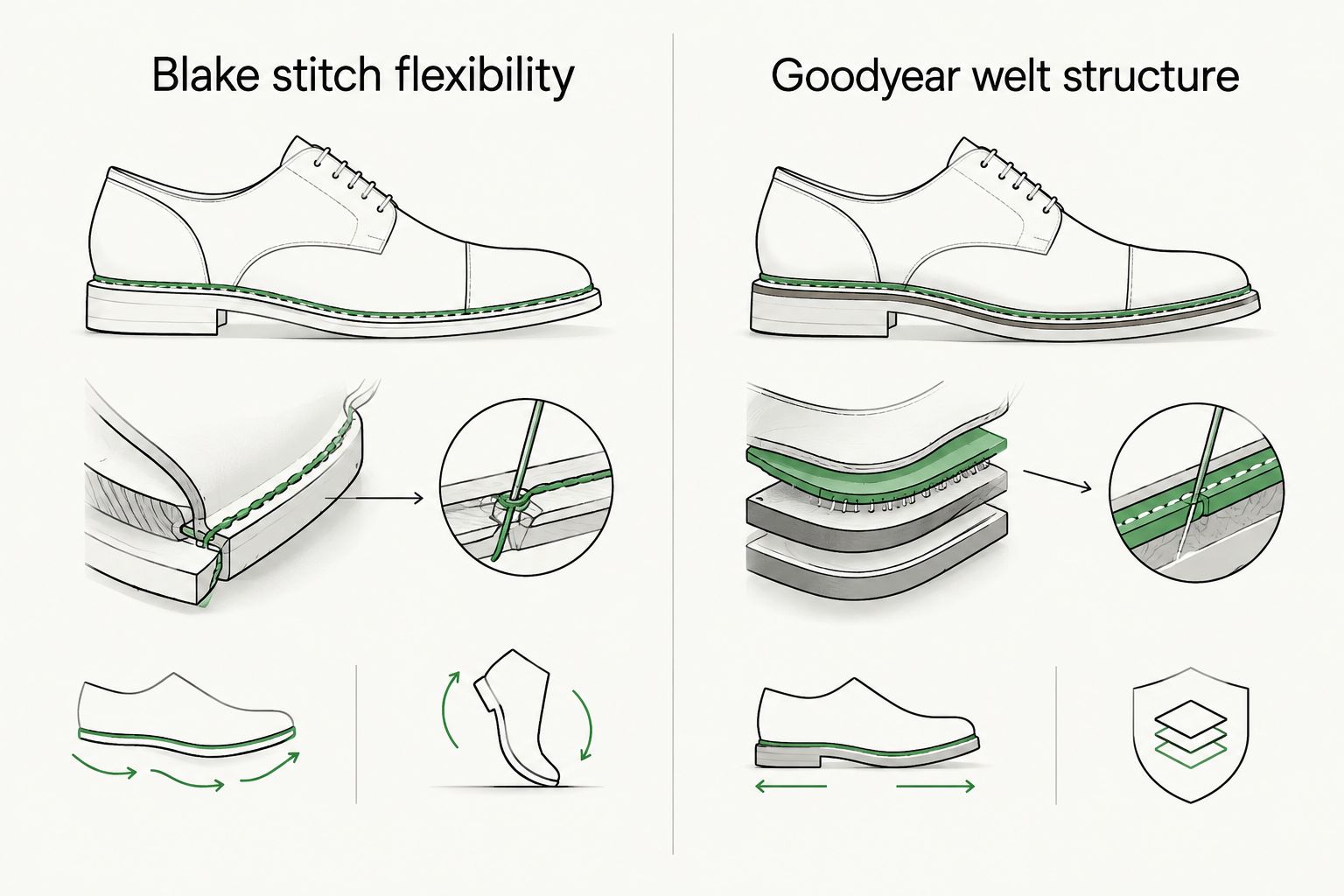
- Blake-stitched shoes suit men who want flexibility from the first wear
- Goodyear-welted shoes suit men who prioritize durability and resoling over immediate softness
- A Blake-stitched slip-on is often the fastest path to bunion comfort out of the box
- If you already own Goodyear-welted shoes that hurt, extra break-in time usually resolves it
- Ask about construction type before buying if the product listing does not specify it
Step 7: Keep the leather supple with regular care
Leather that dries out gets stiffer, and stiffer leather presses harder on a bunion. Conditioning is not optional maintenance for this segment, it is part of the fit strategy.
- Condition leather uppers every four to six wears in regular rotation
- Use a dedicated suede brush and protector spray on suede uppers rather than leather conditioner
- Let shoes air out fully between wears before conditioning
- Avoid over-saturating leather with oil-based products, which can soften structure too much
Comparing shoe options for men with bunions
| Option | Best for | Key limitation | Verdict |
|---|---|---|---|
| Monk strap loafers | Men who want an adjustable, dressy closure | Strap placement can still sit close to the vamp on wide feet | Buy |
| Suede slip-on loafers | Men who want zero lacing pressure and fast break-in | Suede needs protector spray and more frequent care | Buy |
| Velvet loafers | Evening and smart-casual wear with soft, giving uppers | Less durable for daily rotation than calf leather | Buy for occasion wear |
| Traditional lace-up oxfords | Men who need a formal, structured toe for business settings | Lacing panel closes tight across the bunion joint | Skip unless custom-fitted |
Common mistakes men with bunions make when buying Italian dress shoes
- Sizing up in length instead of width. A longer shoe with the same narrow last just adds dead space at the toe while the bunion still presses on the same tight point.
- Buying for the shoe's look, not its last shape. A pointed toe photographs well and hurts within an hour of wear.
- Skipping the break-in period entirely. Wearing a brand-new pair for a full workday or a wedding is how a mild bunion becomes an inflamed one.
- Ignoring construction type. A stiff, heavily corrected Goodyear-welted oxford and a soft Blake-stitched slip-on can be the same size on paper and feel completely different on a bunion.
- Choosing patent leather for formal events. Patent leather has almost no give, and a formal event is the worst place to discover a shoe doesn't flex.
FAQ
What are the best Italian dress shoes for bunions?
Monk strap loafers with an adjustable buckle and suede slip-on loafers work best for bunions in 2026 because they avoid a tight lacing panel across the forefoot. Rounded or almond toe shapes matter as much as the closure style.
Do slip-on loafers work better than lace-up oxfords for bunions?
Yes, slip-on loafers generally work better because they have no lacing panel pulling tight across the widest part of the foot. Lace-up oxfords can still work if the last is wide and the toe is rounded.
Should men with bunions buy a half size up?
No, sizing up in length rarely solves a bunion problem. The fix is a wider fit or a different last shape, not extra room at the toe tip.
Can suede stretch to accommodate a bunion?
Suede stretches faster than smooth calfskin because of its napped fiber structure, and it often molds to a mild bunion within a few wears. A professional stretch over a shoe last can add more room if needed.
Are monk strap shoes good for bunions?
Monk strap shoes are a strong option for bunions because the buckle closure can be adjusted independently of the rest of the fit. This lets you loosen the shoe specifically over the bunion side.
Is a wider shoe width enough, or does toe shape matter too?
Width alone is not enough if the toe still tapers to a point. Toe shape and width both need to accommodate the bunion, which is why a rounded or almond last matters as much as a wide-width designation.
How do I know if my Italian dress shoes are too narrow for my bunion?
Redness, a visible indent, or numbness after a few hours of wear are signs the shoe is too narrow. Any of these after a single wear means the shoe is the wrong last shape, not just a break-in issue.
Can leather dress shoes be professionally stretched for a bunion?
Yes, a shoe repair professional can stretch leather over a last to add width or create a small bump-out specifically for a bunion. This works best on natural leather and suede rather than heavily coated or patent finishes.
One last thing
Suede does more for a bunion than most men expect from a material choice alone. Its napped fiber structure gives faster and more evenly than smooth calfskin, which means a suede slip-on often solves in two or three wears what a professional stretch takes a full appointment to fix on a stiffer leather. If you're choosing between two otherwise similar loafers, let the upper material be the deciding factor in 2026, not the color or the toe detail.