

Italian leather shoes typically take two to four weeks of regular, rotated wear to break in, and the first few wears are where most of the adjustment happens. That window assumes the shoes fit correctly in length and width from day one; a shoe that is the wrong size never breaks in, it only wears out your feet.
- Plan on two to four weeks of rotated wear to break in Italian leather shoes.
- Structured calfskin oxfords and boots take longest; softer loafers adjust fastest.
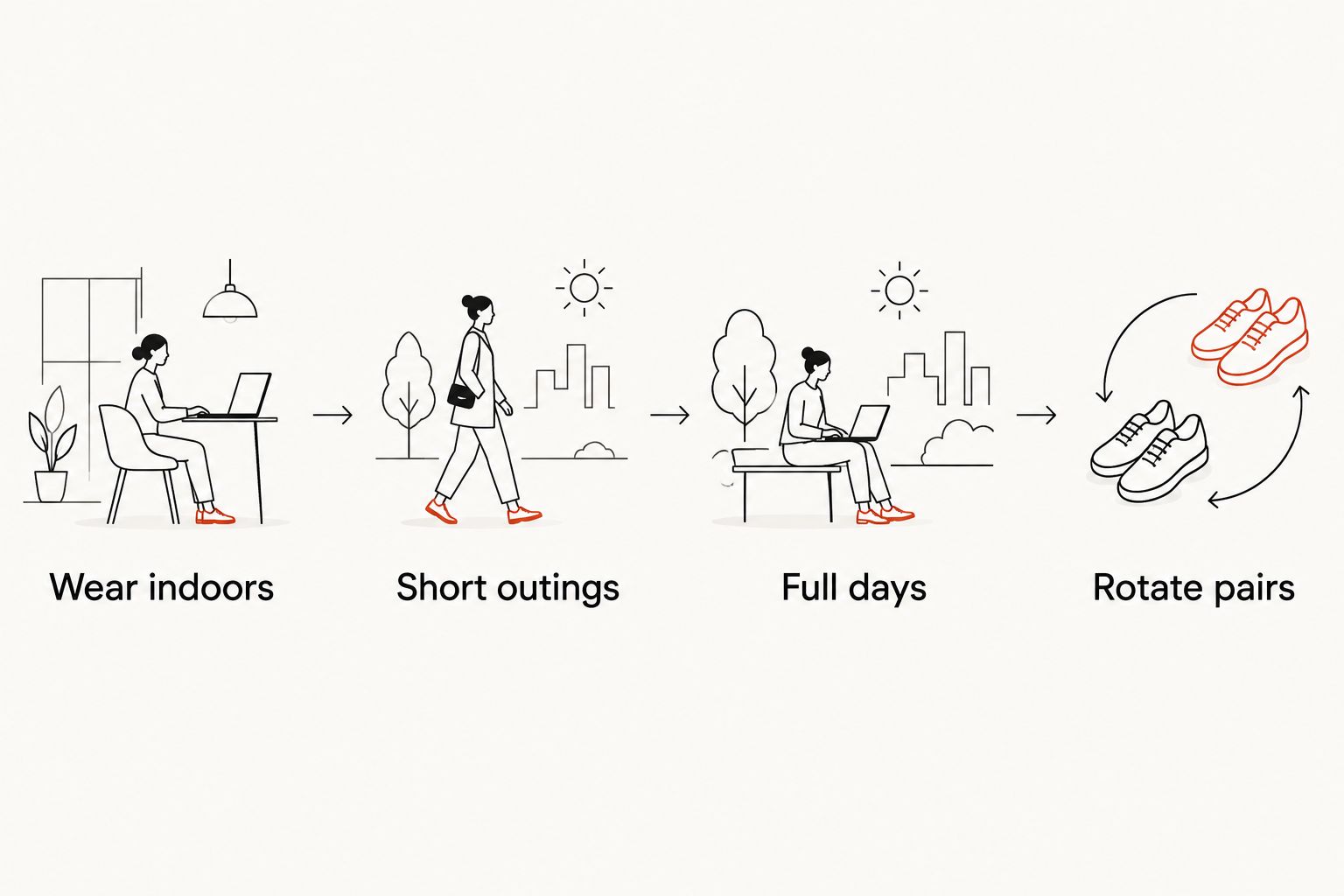
- Wear new pairs in short stretches, then build to full days, and rest each pair a day between wears.
- Pinching across the ball or heel slip after a month signals a fit problem, not a break-in problem.
Break-in is the period in which the leather softens at the flex point, the footbed takes the shape of your foot, and the heel counter settles around your heel. Fine footwear is built to hold its shape, so some firmness at the start is normal. Pain is not. The rest of this page separates the two and gives you a schedule you can follow. For the full walkthrough on standard dress shoes, see our guide on how to break in new leather dress shoes.
How long does it take to break in Italian leather shoes?
The answer for most pairs is two to four weeks, counting actual wearing days rather than calendar days. If you wear them twice a week, expect the full process to stretch toward the longer end. If you wear them most days with a rest day in between, you will land nearer the shorter end.
The number moves with construction and leather. Use this as a working guide for 2026 purchases:
| Shoe type | What to expect | Best approach |
|---|---|---|
| Soft calfskin loafers | Settle fastest, often within the first few wears | Short outings, then full days |
| Calfskin oxfords and derbies | Firmer at the start, typically the full two to four weeks | Build wear gradually, use shoe trees |
| Boots and chukkas | Stiffer around the ankle and collar, often the longest to settle | Wear with the socks you plan to use daily |
| Monk straps | Strap and buckle area needs time to flex | Adjust the strap position over the first wears |
| Exotic skins such as crocodile or alligator | Scales flex differently from smooth calf | Gentle, short wears; avoid forcing creases |
The table describes tendencies, not guarantees. A well-made shoe in a good fit can feel comfortable on day one, and a stiff boot can need more than a month.
Why break-in time varies
Several factors decide whether your pair takes two weeks or six:
- Leather thickness and tannage. Heavier, more tightly tanned leather resists flexing longer than soft, supple calf.
- Lining. Fully lined shoes generally feel more structured at first than lightly lined or unlined pairs.
- Construction. A stiff sole and firm heel counter hold their shape and take longer to soften than a flexible, lighter build.
- Fit. A pair that is correct in length but slightly narrow will feel tight for longer, and a pair that is too tight will not resolve. Width matters as much as size, which is covered in how to choose the right shoe width for a proper fit.
- Your foot. High arches, wide forefeet, bunions and narrow heels each press on different parts of the shoe, so the sore spots differ from person to person.
- How often you wear them. Frequent short wears do more than one long, painful day.
Break in Italian leather shoes, step by step
The method is simple. It is also the part people skip, which is why they end up with blisters.
- Start at home. Wear the shoes indoors with the socks you intend to wear with them. This lets you spot pressure points before the shoes have scuffs, which matters if a return is needed.
- Move to short outings. Wear them for errands or a short commute rather than a full workday. Take them off when you feel a hot spot, not after it becomes a blister.
- Build to full days. Once the first outings feel neutral, wear them for a full day. Keep a second pair available if your feet need a change.
- Rotate. Give each pair a day of rest between wears so the leather dries and recovers. Insert cedar shoe trees when you take them off; they absorb moisture and help the shoe hold its form.
- Condition when needed. Leather that is dry flexes with more resistance. A light conditioning, done correctly, keeps it supple as it settles.
Socks make a measurable difference. Thin dress socks leave more room and more friction, while slightly thicker ones can cushion a stiff heel. Test with the pair you will actually wear. If sock choice is part of what you are sorting out, our guide on choosing sock colors for Italian dress shoes covers pairing, though we do not link it here to save space.
Break-in discomfort versus a bad fit
The most useful distinction on this page is between a shoe that is settling and a shoe that is wrong. Both feel tight at the start. They diverge afterward.
Normal break-in feels like:
- Firmness across the top of the foot that eases within a few wears
- A slightly snug heel that loosens as the counter softens
- Mild stiffness at the flex point where the toes bend
- Creasing beginning across the vamp, which is expected
A fit problem feels like:
- Toes pressed against the end of the shoe at rest
- Pinching across the ball of the foot that does not improve after several wears
- Heel that lifts out with every step, rubbing a blister
- Numbness or sharp pain rather than pressure
If you are past the four-week mark of regular wear and still feel the second list, the shoe is likely the wrong size or width for your foot. Re-measuring at home helps; our guide on how to measure your foot for Italian dress shoes walks through it, though we only count it as a pointer here. Leather can give a little in width, but it does not make up for a length that is too short.
Can you speed up break-in?
You can help it along, but you cannot shortcut it entirely. Wearing the shoes around the house with the right socks, using shoe trees between wears and keeping the leather conditioned all shorten the stiff phase. Aggressive methods, such as soaking the leather or wearing the shoes wet, risk damaging the finish and the structure, and we do not recommend them for fine Italian footwear.
If a pair is snug in a specific spot, a cobbler can stretch it locally. That is usually safer than stretching it yourself at home. The process and its limits are explained in how to stretch leather shoes that are too tight.
Does break-in time differ for exotic leather?
Yes, in approach more than in length. Crocodile and alligator have a scaled surface that does not crease like smooth calf, so the goal is to let the shoe adjust gently rather than flex hard. Short wears, careful storage and no forcing are the sensible rules. Our guide to breaking in crocodile leather loafers covers the specifics.
How many wears before Italian leather shoes feel comfortable?
Most men feel a clear improvement within the first few wears, with the pair settling fully across the two-to-four-week window. Comfort comes in stages: the heel usually settles first, then the vamp, then the flex point.
Should you break in leather shoes before an event?
Yes. Wear a new pair for at least a couple of weeks of short outings before a wedding, interview or long day on your feet. Do not debut a new pair of dress shoes on the day that matters most. A broken-in pair is the one that looks relaxed on your foot in photographs.
Do loafers take less time than oxfords?
Often, yes. Loafers typically have a more flexible, less structured build, and many men find they settle sooner than a closed-lacing oxford or derby. Lacing helps oxfords: you can adjust the tension across the instep to relieve pressure while the leather softens.
What if my heel slips after break-in?
If your heel lifts after the leather has softened, the shoe is probably too large through the heel or too wide overall. Break-in generally loosens a shoe rather than tightening it, so a slightly roomy fit tends to get roomier. Consider a different size or last, or an insole or heel grip as a stopgap.
FAQ
How long does it take to break in Italian leather shoes?
Most pairs take two to four weeks of regular, rotated wear to break in. Soft loafers often settle sooner, while structured oxfords and boots can take the full window or longer.
How many wears does it take to break in leather dress shoes?
The most noticeable change happens in the first few wears. Full comfort usually arrives across the following two to four weeks as the heel, vamp and flex point soften.
Is it normal for new Italian leather shoes to hurt?
Mild firmness is normal, but pain is not. Pressure that eases within a few wears is break-in; sharp pain, numbness or blisters point to a fit issue.
Should I wear new leather shoes all day right away?
No. Start with short wears indoors or on errands, then build to full days. Wearing them all day at once is the most common cause of blisters.
Do shoe trees help break in leather shoes?
Shoe trees do not break shoes in, but they help the leather dry and hold its shape between wears, which supports the settling process.
Can I speed up breaking in Italian leather shoes?
You can help it with the right socks, rotation and conditioning, but you cannot rush it safely. Soaking or forcing the leather risks damaging the finish.
How do I know if my shoes are too small and not just stiff?
If your toes touch the end at rest or the pinching persists after a month of regular wear, the shoes are the wrong size or width. Stiffness fades; a bad fit does not.
Do exotic leather shoes take longer to break in?
They need a gentler approach rather than a longer one. Scaled leathers like crocodile do not crease like calf, so use short wears and avoid forcing the flex.
One last thing
The single best predictor of a short break-in is getting the width right before you buy, because length is easy to check and width is where most pairs go wrong. If you are choosing between two sizes, take the one that lets your foot sit flat without pressing on the sides, and let the leather do the rest in 2026 and beyond. At MensItalianShoes, handmade Italian footwear is meant to be worn in and kept, so patience in the first weeks pays off for years. Explore the full collection at MensItalianShoes.